 by
by Every year, lakhs of graduates apply for the Civil Services Examination (CSE), but only a few hundred make it to the final list of IAS, IPS, IFS and allied service officers. That entire journey – from filling an application form to getting a rank in the final merit list – runs through a fixed, three-tier UPSC Selection Process. For the 2027 examination cycle, the structure remains the same time-tested model the Commission has used for decades, but the dates, vacancy trends and a few procedural rules around attempts and cadre allocation have been updated. This guide breaks down exactly how the UPSC Selection Process 2027 works, stage by stage, with the latest official dates and numbers.
What Is the UPSC Selection Process?
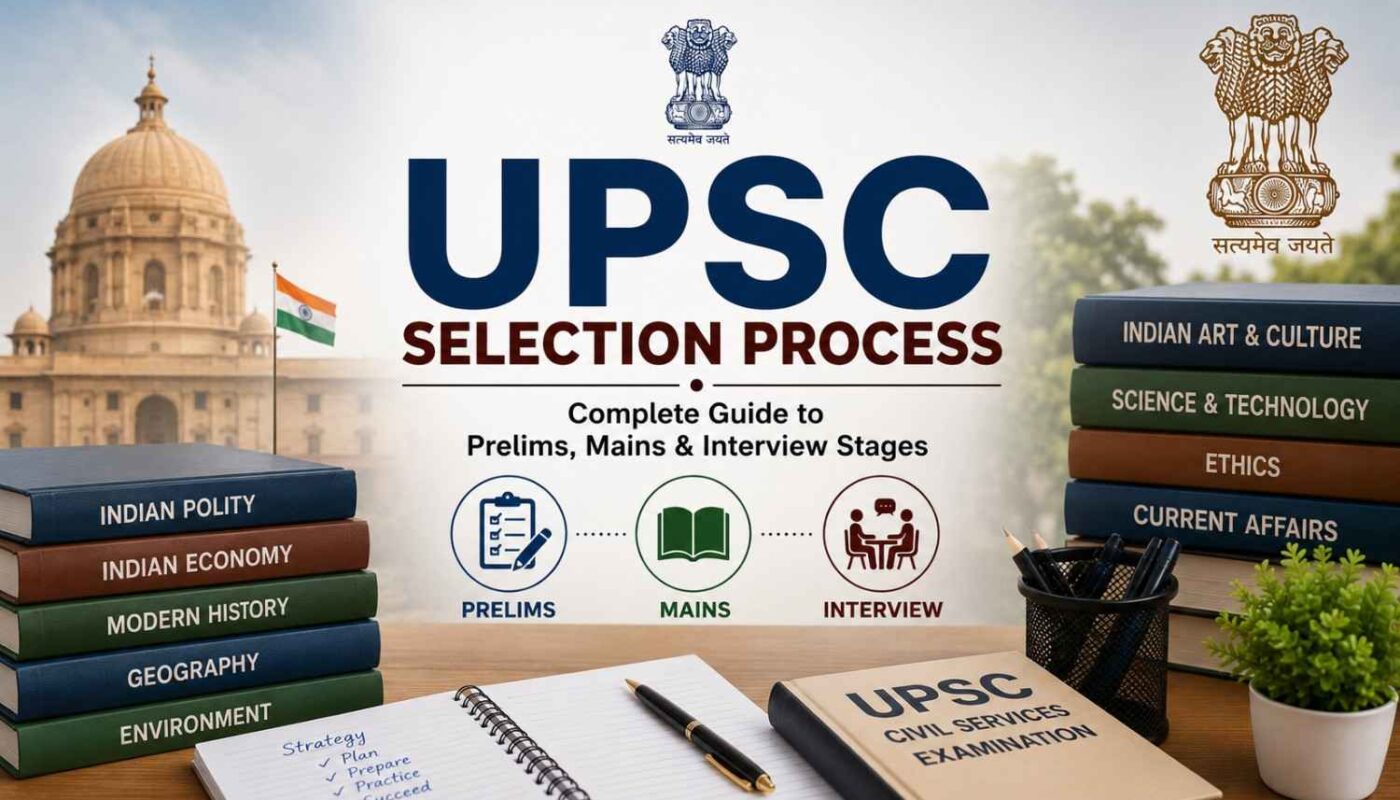
The UPSC Selection Process is the recruitment methodology used by the Union Public Service Commission to shortlist and appoint candidates to Group A and Group B civil services – including IAS, IPS, IFS, IRS, IRPS, IDAS and Group B posts such as DANICS and DANIPS. It is a year-long, three-stage funnel:
- Preliminary Examination – an objective screening test
- Main Examination – a descriptive, merit-deciding written test
- Personality Test (Interview) – the final assessment of suitability
Only after clearing all three does a candidate move to Document Verification and a Medical Examination, which together decide the final service allocation.
UPSC Selection Process 2027: Key Dates at a Glance
The UPSC officially released its Annual Exam Calendar for 2027 on 20 May 2026, giving aspirants nearly a full year of lead time to plan their preparation. Based on this calendar, here is how the CSE 2027 cycle is expected to unfold:
| Stage | Tentative Date | Notes |
| CSE 2027 Notification | 13 January 2027 | Application form and detailed vacancy PDF released |
| Last Date to Apply | 2 February 2027 | Roughly a 3-week application window |
| Preliminary Examination | 23 May 2027 (Sunday) | Single-day, two papers (GS + CSAT) |
| Prelims Result | Expected June 2027 | Cut-off based shortlisting for Mains |
| Main Examination | 20 August 2027 (Friday) onwards | Spread across 5 days |
| Mains Result / DAF-II | Expected December 2027–January 2028 | Detailed Application Form for interview |
| Personality Test (Interview) | Expected February–April 2028 | Conducted at UPSC HQ, New Delhi |
| Final Result | Expected mid-2028 | Service allocation follows |
Note: UPSC itself states that notification, commencement and duration of any exam are subject to change if circumstances demand it, so aspirants should always cross-check dates on upsc.gov.in closer to each stage.
Interestingly, the gap between Prelims and Mains 2027 is roughly three months – a slightly tighter runway than some previous cycles – which makes parallel Mains preparation (rather than starting it only after the Prelims result) a more urgent strategy for the 2027 batch.
UPSC Selection Process 2027: Stage-Wise Marks Distribution
| Stage | Nature | Total Marks | Counted Towards Final Merit? |
| Preliminary Exam | Qualifying only | 400 (200 + 200) | No |
| Main Examination | Descriptive | 1750 | Yes |
| Personality Test | Interview | 275 | Yes |
| Grand Total (Merit) | 2025 | – |
Prelims marks are used only to shortlist candidates for Mains – they don’t add to the final rank. The actual competition for rank is decided purely on the combined 2025 marks of Mains plus Interview.
Stage 1: UPSC Prelims Selection Process
The Preliminary Examination is the first and widest filter, typically narrowing down 10–12 lakh applicants to around 14,000–16,000 candidates eligible for Mains.
It consists of two objective-type (MCQ) papers, conducted on the same day:
| Paper | Subject | Questions | Marks | Duration |
| Paper I | General Studies | 100 | 200 | 2 hours |
| Paper II | CSAT (Civil Services Aptitude Test) | 80 | 200 | 2 hours |
Key rules for Prelims 2027:
- Only GS Paper I marks are used to determine the Mains cut-off; CSAT is purely qualifying.
- CSAT requires a minimum of 33% (66.67 marks out of 200) to qualify.
- Negative marking applies: roughly 0.66 marks deducted per wrong answer in GS, and about 0.83 marks in CSAT.
- The exam is held in both Hindi and English, in offline OMR mode.
- The IFoS (Indian Forest Service) Preliminary Exam is conducted on the same day, using the same GS Paper I and CSAT papers – a detail many first-time aspirants overlook.
Stage 2: UPSC Mains Selection Process 2027
Candidates who clear the Prelims cut-off move to the Main Examination – a set of nine descriptive papers spread over five exam days, each paper being three hours long.
| Paper | Subject | Duration | Marks | Merit-Counted |
| Paper A | Indian Language (qualifying) | 3 hrs | 300 | No |
| Paper B | English (qualifying) | 3 hrs | 300 | No |
| Paper I | Essay | 3 hrs | 250 | Yes |
| Paper II | General Studies I | 3 hrs | 250 | Yes |
| Paper III | General Studies II | 3 hrs | 250 | Yes |
| Paper IV | General Studies III | 3 hrs | 250 | Yes |
| Paper V | General Studies IV | 3 hrs | 250 | Yes |
| Paper VI | Optional Subject Paper 1 | 3 hrs | 250 | Yes |
| Paper VII | Optional Subject Paper 2 | 3 hrs | 250 | Yes |
| Total (Merit) | 1750 |
Points to note for the 2027 cycle:
- Papers A and B are qualifying with a minimum requirement of 25% marks; scoring below this disqualifies the entire candidature, regardless of performance in other papers.
- There is no negative marking in Mains.
- Candidates choose one optional subject out of a list of roughly 48 subjects (including literature options), each carrying two papers.
- Only the seven merit papers (1,750 marks) count towards the final rank at this stage; the qualifying language papers do not add marks but must be cleared.
Stage 3: UPSC Interview / Personality Test Process
Candidates who clear the Mains cut-off are called for the Personality Test, popularly known as the UPSC Interview – the final and most decisive human-assessment stage.
| Particular | Detail |
| Venue | UPSC Headquarters, Dholpur House, Shahjahan Road, New Delhi |
| Reporting Time | Forenoon session: 9:00 AM / Afternoon session: 1:00 PM |
| Dress Code | Formals |
| Duration | 20–30 minutes (varies by board and candidate) |
| Total Marks | 275 |
| Candidates Called | Roughly twice the number of vacancies |
The interview board – usually chaired by a UPSC Member or a senior expert – evaluates a candidate’s mental alertness, clarity of thought, balance of judgment, integrity, and capacity for leadership rather than testing bookish knowledge. It is not a cross-examination on facts; it is an assessment of how a future administrator thinks, reacts and communicates under pressure.
Document Verification & Medical Examination
Once a candidate clears the interview, two administrative checks decide whether the provisional selection turns into a confirmed appointment:
1. Document Verification (DV): Conducted around the interview stage, this involves scrutiny of original certificates – educational qualifications, age proof, category and PwBD certificates, and other documents submitted in the Detailed Application Form (DAF) – to confirm eligibility.
2. Medical Examination: Candidates are examined at a designated government hospital to confirm they meet the physical and medical standards prescribed in the official notification. This step carries particular weight for uniformed services like the IPS, where specific physical fitness benchmarks apply.
Only after clearing both does UPSC finalise a candidate’s name in the official merit list and proceed to service allocation.
What’s New for the UPSC Selection Process 2027
While the three-stage architecture is unchanged, a few developments are directly relevant to the 2027 aspirant batch:
- Vacancy trend: UPSC CSE 2026 was notified with 933 vacancies, continuing a gradual decline from the 1,000+ range seen in 2023–2024. The formal CSE 2027 vacancy figure will only be confirmed with the January 2027 notification, but aspirants should factor in a similarly competitive, sub-1,000 vacancy environment while planning strategy.
- Attempt and cadre-allocation rules: UPSC has tightened certain re-allocation rules for candidates already serving in IPS or Group A services who wish to reattempt in 2027 – such candidates now need a one-time training exemption to appear again, and cannot be re-allocated back into IPS. This mainly affects working officers attempting a rank improvement, not fresh aspirants.
- One Time Registration (OTR) and live photo/face authentication continue to be mandatory at the application stage to prevent impersonation – a process reform introduced in recent cycles and expected to continue for 2027.
- Shorter Prelims-to-Mains gap: With Prelims on 23 May 2027 and Mains from 20 August 2027, the roughly 90-day window is on the tighter side, reinforcing the need to start Mains-oriented answer writing well before the Prelims result is out.
UPSC Selection Process 2027: Quick Preparation Timeline
| Phase | Window | What to Prioritise |
| Now – Jan 2027 | ~7 months | Build static GS foundation, lock your optional subject, start a daily current affairs habit |
| Jan – May 2027 | ~4 months | Intensive Prelims revision, CSAT practice, full-length mock tests |
| May – Aug 2027 | ~3 months | Mains answer writing, essay practice, optional subject depth, current affairs consolidation |
| Aug 2027 onwards | Post-Mains | DAF-II preparation, interview groundwork, mock interviews |
Frequently Asked Questions: UPSC Selection Process 2027
There are three stages – Preliminary Examination, Main Examination, and Personality Test (Interview) – followed by Document Verification and a Medical Examination before final appointment.
As per the official UPSC Calendar, Prelims 2027 is scheduled for 23 May 2027 (Sunday), and Mains 2027 is scheduled to begin on 20 August 2027 (Friday), running for five days.
No. The Preliminary Examination is purely qualifying in nature. Only Mains (1,750 marks) and Interview (275 marks) – a combined 2,025 marks – determine the final rank.
Candidates must score at least 33% (66.67 out of 200 marks) in CSAT to qualify for evaluation of the GS Paper I answer sheet.
UPSC generally calls roughly twice the number of notified vacancies for the Personality Test round.
No. Negative marking applies only in the Preliminary Examination, not in the Mains.
Candidates proceed to Document Verification and a Medical Examination. Only after both are cleared is a candidate’s name confirmed in the final merit list and allotted a service/cadre.
The official vacancy figure for CSE 2027 will be announced with the notification on 13 January 2027. As a reference, CSE 2026 was notified with 933 vacancies.
This article is prepared and periodically reviewed by the Edu Mentor Pro content team, which includes UPSC Mains and Interview-qualified faculty. All exam dates are based on the official UPSC Annual Calendar 2027 released on 20 May 2026; candidates should verify final dates on upsc.gov.in, as UPSC reserves the right to alter schedules.