 by
by Last updated: 10 July 2026 | Fact-checked against the official UPSC Notification 2026, the UPSC Calendar 2026, and the Civil Services Examination Rules
The Civil Services Examination (CSE) 2026 cycle is already underway. The UPSC Notification 2026 was released on 4 February 2026 for 933 vacancies, the Prelims Examination was conducted on 24 May 2026, and results were declared on 15 June 2026. Candidates who qualified are now preparing for the UPSC Mains 2026, scheduled to commence on 21 August 2026 and run for five days. This makes the current window – roughly six weeks out from Mains – the most critical stretch of the entire cycle for shortlisted candidates, while fresh aspirants planning their first attempt should use this time to build a complete, syllabus-first foundation for the next cycle.
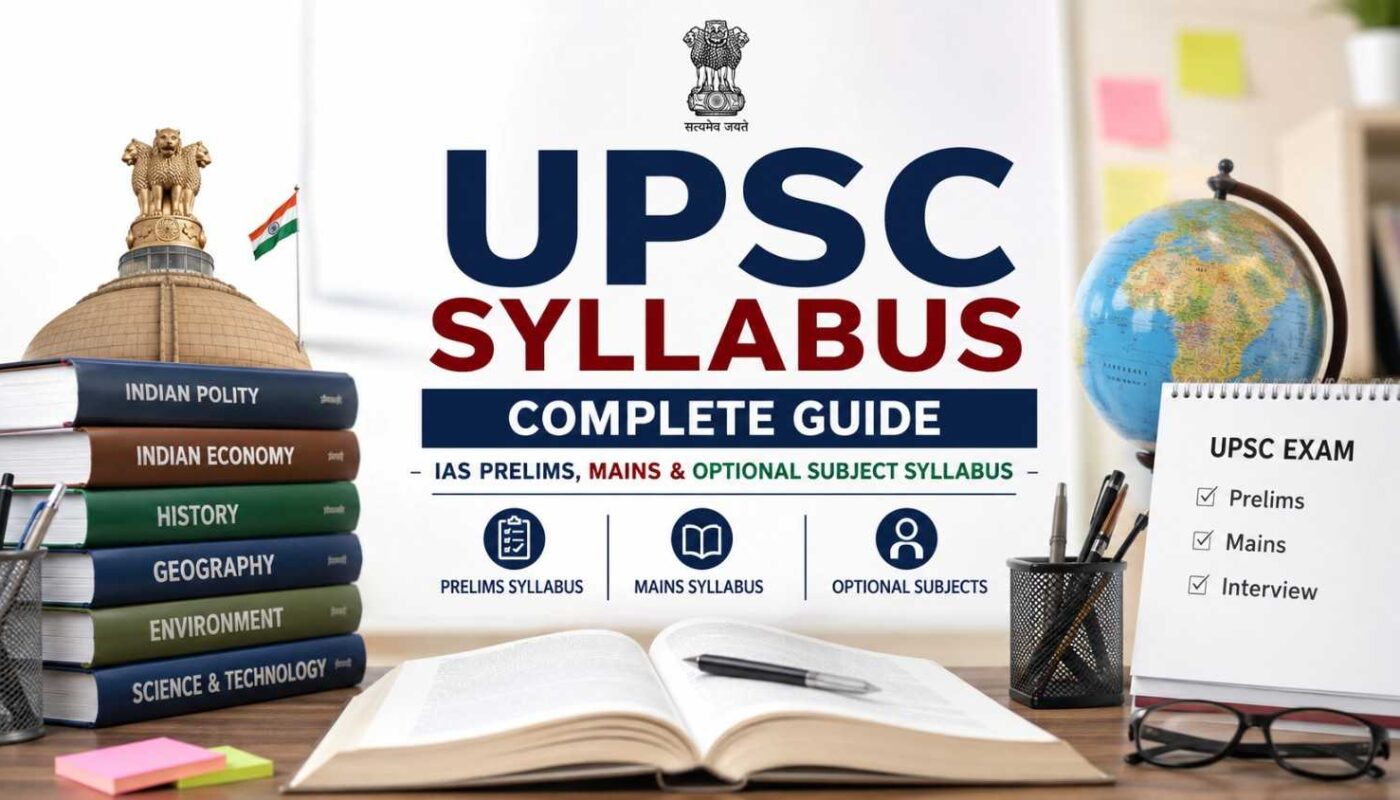
This guide covers the full UPSC Syllabus 2026 – the exact exam pattern, marks distribution, Prelims and Mains topic-wise syllabus, CSAT coverage, and all 48 optional subjects – along with where the 2026 cycle currently stands.
UPSC CSE 2026: Key Dates and Status Check
| Particulars | Details | Status |
| Notification Release | 4 February 2026 | Released |
| Application Window | 4 February – 24 February 2026 | Closed |
| Correction Window | 28 February – 3 March 2026 | Closed |
| Total Vacancies | 933 (including 33 for PwBD candidates) | Confirmed |
| Prelims Exam Date | 24 May 2026 (Sunday) | Conducted |
| Prelims Result | 15 June 2026 | Declared |
| Mains Exam Date | 21–25 August 2026 (5 days) | Upcoming |
| IFoS Mains (for combined candidates) | 22 November 2026 | Upcoming |
| Personality Test | Expected early–mid 2027 | Pending |
| Official Website | upsc.gov.in | – |
Note: UPSC also introduced live webcam-based photo capture during the 2026 application process, replacing uploaded scanned photographs – a procedural change worth knowing if you are documenting this cycle for reference or guiding other aspirants.
UPSC Exam Pattern 2026: Full Structural Breakdown
Before diving into topic-wise syllabus, it helps to understand exactly how each stage is scored, because the pattern determines where your preparation time should go.
Stage 1: Preliminary Examination Pattern
| Aspect | Paper I: General Studies | Paper II: CSAT |
| Duration | 2 hours | 2 hours |
| Total Marks | 200 | 200 |
| Number of Questions | 100 | 80 |
| Marks per Correct Answer | +2 | +2.5 |
| Negative Marking | −0.66 per wrong answer (⅓rd) | −0.83 per wrong answer (⅓rd) |
| Role in Selection | Counts toward Mains cut-off | Qualifying only – minimum 33% (66/200) |
| Question Type | Objective (MCQ) | Objective (MCQ) |
| Medium | Hindi and English | Hindi and English |
Both papers are held on the same day. The Indian Forest Service (IFoS) Preliminary Examination is conducted jointly with CSE Prelims using the same GS Paper I, so combined CSE–IFoS applicants sit only one Prelims paper for both services.
Stage 2: Main Examination Pattern
| Paper | Subject | Marks | Nature |
| Paper A | Indian Language (Eighth Schedule) | 300 | Qualifying (25% minimum) |
| Paper B | English | 300 | Qualifying (25% minimum) |
| Paper I | Essay | 250 | Merit |
| Paper II | GS-I: History, Culture & Society | 250 | Merit |
| Paper III | GS-II: Governance, Polity & IR | 250 | Merit |
| Paper IV | GS-III: Economy, S&T, Environment, Security | 250 | Merit |
| Paper V | GS-IV: Ethics, Integrity & Aptitude | 250 | Merit |
| Paper VI | Optional Subject Paper 1 | 250 | Merit |
| Paper VII | Optional Subject Paper 2 | 250 | Merit |
| Written Total | 1750 |
Stage 3: Personality Test (Interview)
| Aspect | Details |
| Marks | 275 |
| Nature | Merit – added to Mains written score |
| Purpose | Assesses mental alertness, judgment, social cohesion and leadership potential rather than factual recall |
| Grand Total (Mains + Interview) | 2025 marks – final merit basis |
Prelims marks are never added to the final score; they only determine who advances to Mains.
UPSC Prelims Syllabus 2026
GS Paper I Topics
- Current events of national and international importance – schemes, summits, defence exercises, science and tech developments, and appointments reported through the year
- History of India and the Indian National Movement – Ancient, Medieval and Modern India, including the socio-religious reform movements and the freedom struggle
- Indian and World Geography – physical, social and economic geography of India and the world
- Indian Polity and Governance – Constitution, political system, Panchayati Raj, public policy, Rights issues
- Economic and Social Development – sustainable development, poverty, inclusion, demographics, welfare schemes
- Environmental Ecology, Biodiversity and Climate Change – general awareness, no specialised background required
- General Science – everyday science and current developments in technology and health
CSAT (GS Paper II) Topics
- Comprehension
- Interpersonal skills including communication
- Logical reasoning and analytical ability
- Decision-making and problem-solving
- General mental ability
- Basic numeracy (Class X level) – numbers, ratios, percentages, time-speed-distance
- Data interpretation – charts, graphs, tables, data sufficiency
Practical note for the current cycle: since Prelims 2026 is already over, candidates now preparing for Mains should shift almost entirely to descriptive answer writing; those planning for a future attempt should still budget two structured CSAT sessions weekly from day one, since it remains a common reason for otherwise well-prepared candidates to be screened out.
UPSC Mains Syllabus 2026
GS Paper-I: Indian Heritage, History and Geography of Society
Indian art forms, literature, architecture; modern Indian history from the mid-18th century; the freedom struggle; post-independence consolidation; world history since the 18th century; Indian society’s diversity, women’s issues, urbanisation, and globalisation’s social impact; world physical geography and resource distribution.
GS Paper-II: Governance, Constitution, Polity, Social Justice and International Relations
Constitutional evolution and structure; Centre-State relations; Parliament, judiciary, executive; statutory and quasi-judicial bodies; welfare schemes for vulnerable sections; e-governance; India’s bilateral, regional and global relationships.
GS Paper-III: Technology, Economic Development, Environment, Security and Disaster Management
Economic planning and inclusive growth; government budgeting; agriculture and food security; industrial policy and infrastructure; science and technology applications; IPR; environmental conservation; disaster management; internal security including cyber security and border management.
GS Paper-IV: Ethics, Integrity and Aptitude
Case-study-based paper testing foundations of ethics, emotional intelligence, contributions of moral thinkers, public service values, and probity in governance.
Essay Paper
Two essays chosen from a range of philosophical, social, economic and political themes, evaluated on structure, originality and balanced argumentation.
UPSC Optional Subject Syllabus 2026
UPSC offers 48 optional subjects – 25 core subjects and 23 literature subjects – examined through two papers of 250 marks each (500 marks total), the single largest scoring component after the combined GS papers.
Core Optional Subjects (25): Agriculture, Animal Husbandry & Veterinary Science, Anthropology, Botany, Chemistry, Civil Engineering, Commerce & Accountancy, Economics, Electrical Engineering, Geography, Geology, History, Law, Management, Mathematics, Mechanical Engineering, Medical Science, Philosophy, Physics, Political Science & International Relations, Psychology, Public Administration, Sociology, Statistics, Zoology.
Literature Optional Subjects (23): Assamese, Bengali, Bodo, Dogri, Gujarati, Hindi, Kannada, Kashmiri, Konkani, Maithili, Malayalam, Manipuri, Marathi, Nepali, Oriya, Punjabi, Sanskrit, Santali, Sindhi, Tamil, Telugu, Urdu, English.
Choose based on syllabus overlap with GS (Public Administration, Political Science, Sociology and Geography all overlap meaningfully), availability of guidance and material, and genuine interest – since the optional demands the most sustained depth of study in the entire exam.
Eligibility Snapshot for CSE 2026
- Educational Qualification: Bachelor’s degree from a recognised university; final-year students may apply for Prelims but must furnish proof of graduation before Mains
- Age Limit: 21 to 32 years as on 1 August 2026 (born between 2 August 1994 and 1 August 2005 for the General category)
- Age Relaxation: SC/ST up to 5 years; OBC up to 3 years; PwBD up to 10 years; Ex-servicemen up to 5 years
- Number of Attempts: General/EWS – 6 attempts; OBC (GL/EWS/OBC) – 9 attempts; SC/ST – unlimited attempts up to the upper age limit
- Application Fee: ₹100 for General/OBC candidates; women, SC, ST, and PwBD candidates are exempted
What’s New in the 2026 Cycle
- The UPSC CSE 2026 notification, originally expected on 14 January 2026, was actually released on 4 February 2026 – a reminder that tentative calendar dates can shift, and the official notification always overrides the earlier calendar estimate.
- UPSC introduced mandatory live webcam photo capture during online registration for 2026, replacing the older upload-a-scanned-photo process.
- The core Prelims, Mains and optional syllabus itself remains unchanged for 2026 under the existing Civil Services Examination Rules – no new papers or topics have been added.
- With Mains just weeks away, current affairs from the past 12–15 months (Union Budget 2026-27 announcements, recent Supreme Court judgments, new international agreements, and government scheme updates) deserve focused revision alongside static GS content.
How to Use This Syllabus: A Practical Study Approach
- If you’re preparing for Mains 2026 right now: prioritise daily answer writing under time limits, revise your optional subject syllabus paper-wise, and integrate the last 12–15 months of current affairs into every GS paper rather than reading it separately.
- If you’re a fresh aspirant targeting a future cycle: start with NCERT and standard reference texts to build static foundations, then layer current affairs on top subject-wise.
- Treat CSAT as non-negotiable, even though it’s qualifying – regular practice from month one prevents last-minute panic.
- Choose your optional subject early so you have adequate time to complete both papers alongside General Studies.
- Build a revision cycle, not a single read-through – three to four structured passes before Prelims and dedicated answer-writing practice ahead of Mains.
Frequently Asked Questions on UPSC Syllabus 2026
No. The Prelims, Mains and optional syllabi remain governed by the existing Civil Services Examination Rules; only administrative procedures (such as photo verification) have been updated for this cycle.
The Civil Services Main Examination 2026 is scheduled to commence on 21 August 2026 and will run for five days.
933 vacancies, including 33 reserved for Persons with Benchmark Disability (PwBD), across 21 different services.
No. CSAT (GS Paper II) is qualifying in nature, requiring a minimum of 33% (66/200); only GS Paper I marks determine the Mains cut-off.
UPSC offers 48 optional subjects (25 core, 23 literature); a candidate selects only one, examined across two papers worth 500 marks total.
2025 marks – 1750 from the seven merit-counted Mains papers plus 275 from the Personality Test (Interview). Prelims marks are not added.
General/EWS candidates get 6 attempts, OBC candidates get 9 attempts, and SC/ST candidates have unlimited attempts within the prescribed age limit.
This article has been compiled and fact-checked against the official UPSC CSE 2026 Notification, the UPSC Calendar 2026, and the Civil Services Examination Rules published by the Union Public Service Commission. For any date, eligibility or syllabus-related decision, always treat upsc.gov.in as the final authority, since notifications and schedules are subject to official revision.