 by
by Last updated: 20 July 2026 | Reviewed against the official UPSC Calendar 2027 and the UPSC Civil Services Examination Rules
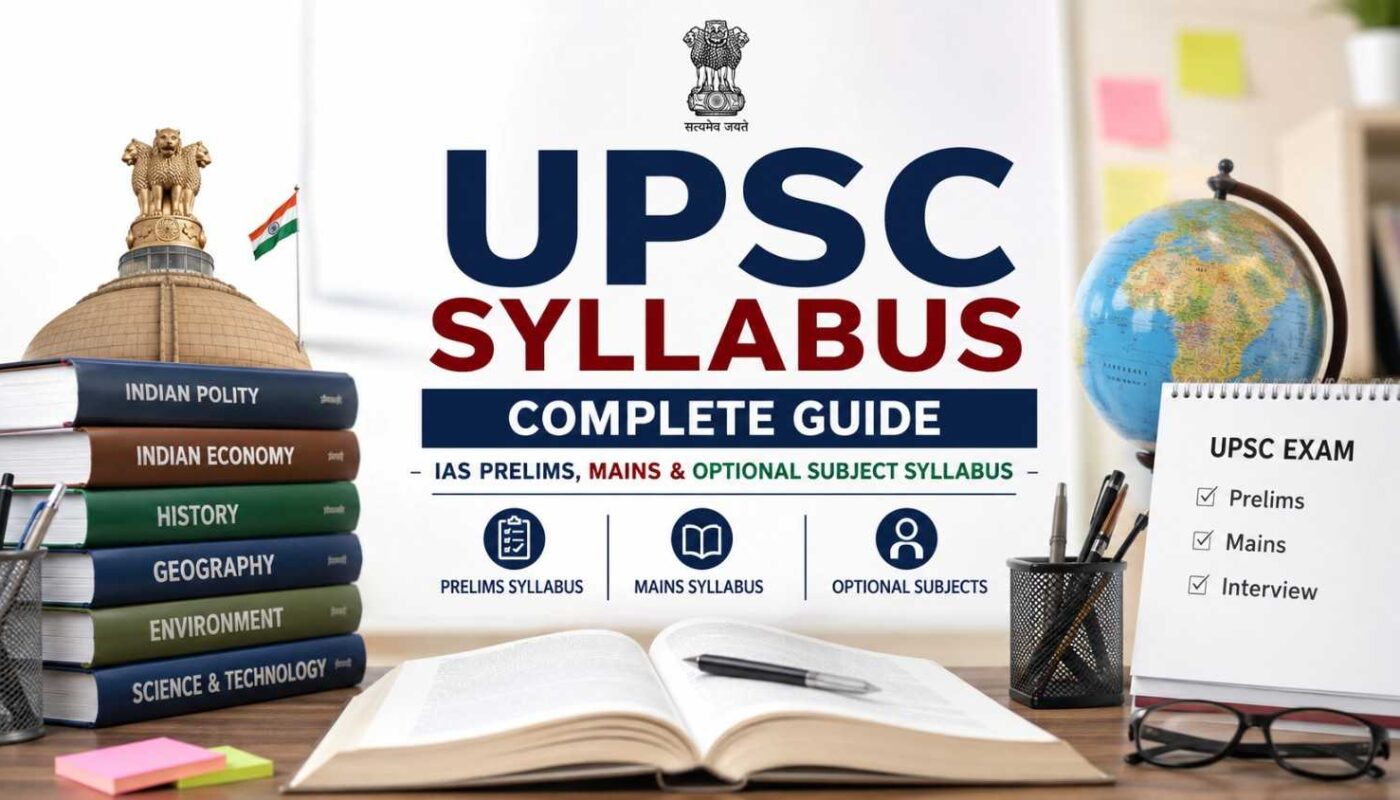
The Union Public Service Commission (UPSC) has released the UPSC Calendar 2027, confirming that the Civil Services Examination (CSE) 2027 notification will be published on 13 January 2027, with Prelims scheduled for 23 May 2027 and Mains beginning 20 August 2027. While UPSC has not announced any structural change to the exam pattern for 2027, aspirants should build their preparation around the official syllabus, because even small shifts in emphasis (current affairs weightage, new government schemes, or fresh Supreme Court judgments) can affect how each topic is tested.
This guide lays out the entire UPSC Syllabus 2027 – Prelims, Mains, CSAT, and all 48 optional subjects – in one place, along with the exam pattern, marking scheme, and practical tips on how to sequence your study plan for the 2027 cycle.
Quick Snapshot: UPSC CSE 2027 at a Glance
| Particulars | Details |
| Conducting Body | Union Public Service Commission (UPSC) |
| Exam Name | Civil Services Examination (CSE) 2027 |
| Notification Date | 13 January 2027 (tentative, per UPSC Calendar 2027) |
| Application Closing Date | 2 February 2027 (tentative) |
| Prelims Exam Date | 23 May 2027 |
| Mains Exam Date | 20–24 August 2027 (5 days) |
| Exam Stages | Prelims → Mains → Personality Test (Interview) |
| Total Marks (Mains + Interview) | 2025 |
| Official Website | upsc.gov.in |
Because the exam is nearly 10–11 months away from the Prelims date, this is the ideal window to map the entire syllabus, identify weak areas, and build a realistic revision cycle rather than rushing through topics later.
UPSC Exam Pattern 2027: Three-Stage Selection Process
The Civil Services Examination is conducted in three successive stages, and a candidate must clear each stage to proceed to the next:
- Preliminary Examination – Two objective papers (screening stage; marks not counted for final merit)
- Main Examination – Nine descriptive papers (written marks count for merit)
- Personality Test / Interview – Conducted by a UPSC board (marks count for merit)
Only the Mains written score (1750 marks) and Interview score (275 marks) are added together to prepare the final merit list, totalling 2025 marks. Prelims acts purely as a qualifying/screening round.
UPSC Prelims Syllabus 2027
The Preliminary Examination is held on a single day and comprises two compulsory papers, both objective (MCQ) in format.
Prelims Exam Pattern
| Aspect | Paper I: General Studies | Paper II: CSAT |
| Duration | 2 hours | 2 hours |
| Total Marks | 200 | 200 |
| Number of Questions | 100 | 80 |
| Marks per Correct Answer | +2 | +2.5 |
| Negative Marking | −0.66 (1/3rd) | −0.83 (1/3rd) |
| Nature | Counts toward Mains cut-off | Qualifying only (minimum 33%) |
| Medium | Hindi and English | Hindi and English |
Note: The Indian Forest Service (IFoS) Preliminary Examination is conducted through the same GS Paper I as the CSE Prelims, so IFoS aspirants must also prepare this syllabus thoroughly.
GS Paper I Syllabus – Topic-Wise Breakdown
- Current events of national and international importance – government schemes, policy announcements, international summits, awards, defence exercises, and science/tech developments reported through the year
- History of India and the Indian National Movement – Ancient India (Vedic age, Mauryan and Gupta periods), Medieval India (Delhi Sultanate, Mughal administration, Bhakti–Sufi movements), Modern India (colonial policies, socio-religious reform movements, 1857 revolt), and the freedom struggle from Gandhi’s entry to Independence
- Indian and World Geography – physical geography (landforms, climate, rivers, soils), human and economic geography (population, resources, industries, trade patterns)
- Indian Polity and Governance – the Constitution, Fundamental Rights and Duties, Directive Principles, the structure of Parliament and the judiciary, Panchayati Raj, constitutional amendments, and landmark judgments
- Economic and Social Development – sustainable development, poverty and inclusion, demographics, welfare schemes, and basic economic indicators such as inflation, fiscal deficit, and GDP
- Environmental Ecology, Biodiversity and Climate Change – ecosystems, conservation programmes, international climate agreements, and India’s environmental policy framework – a section that does not require specialised science background
- General Science – everyday applications of physics, chemistry and biology, along with recent developments in biotechnology, space technology and health science
CSAT (GS Paper II) Syllabus
CSAT is qualifying in nature but eliminates a meaningful share of aspirants each year, so it cannot be treated casually.
- Comprehension and passage-based reasoning
- Interpersonal and communication skills
- Logical reasoning and analytical ability (syllogisms, coding-decoding, blood relations, direction sense)
- Decision-making and problem-solving (largely non-negative-marked)
- General mental ability (series, analogies, pattern recognition)
- Basic numeracy of Class X standard – number systems, percentages, ratios, time-speed-distance, profit and loss
- Data interpretation – tables, bar/line/pie charts, data sufficiency
Practical tip: Only GS Paper I marks decide your Mains cut-off, but scoring below 33% in CSAT disqualifies your entire Prelims attempt regardless of GS Paper I performance. Build in at least two CSAT-focused practice sessions a week from the very start of preparation.
UPSC Mains Syllabus 2027
The Main Examination is a descriptive, subjective-type test spread across five days and nine papers. It evaluates depth of knowledge, structured argumentation, and writing ability – qualities that daily current-affairs reading alone cannot build.
Mains Exam Structure and Marks Distribution
| Paper | Subject | Marks | Counted for Merit? |
| Paper A | Indian Language (Eighth Schedule) | 300 | No – qualifying (25% minimum) |
| Paper B | English | 300 | No – qualifying (25% minimum) |
| Paper I | Essay | 250 | Yes |
| Paper II | GS-I: Indian Heritage, History & Geography of Society | 250 | Yes |
| Paper III | GS-II: Governance, Constitution, Polity, IR, Social Justice | 250 | Yes |
| Paper IV | GS-III: Technology, Economy, Environment, Security, Disaster Management | 250 | Yes |
| Paper V | GS-IV: Ethics, Integrity and Aptitude | 250 | Yes |
| Paper VI | Optional Subject – Paper 1 | 250 | Yes |
| Paper VII | Optional Subject – Paper 2 | 250 | Yes |
| Written total | 1750 | ||
| Personality Test | Interview | 275 | Yes |
| Grand Total | 2025 |
GS Paper-I: Indian Heritage, History and Geography of Society
Covers Indian art forms, literature and architecture, modern Indian history from the mid-18th century onward, the freedom struggle, post-independence consolidation, world history since the 18th century (industrial revolution, world wars, decolonisation), Indian society and its diversity, women’s issues, urbanisation, globalisation’s social effects, and world physical geography including the distribution of natural resources and major geophysical phenomena.
GS Paper-II: Governance, Constitution, Polity, Social Justice and International Relations
Covers the historical evolution and basic structure of the Constitution, Centre-State relations, separation of powers, comparison with other democracies, Parliament and state legislatures, the judiciary and executive, statutory and quasi-judicial bodies, welfare schemes for vulnerable groups, e-governance, and India’s bilateral, regional and global engagements.
GS Paper-III: Technology, Economic Development, Biodiversity, Environment, Security and Disaster Management
Covers Indian economic planning, inclusive growth, government budgeting, agriculture (cropping patterns, irrigation, MSP, food security), industrial policy, infrastructure, science and technology applications, IPR, environmental conservation and impact assessment, disaster management, and internal security challenges including cyber security and border management.
GS Paper-IV: Ethics, Integrity and Aptitude
A distinctive paper that uses case studies to test a candidate’s approach to probity in public life. Covers the foundations of ethics, attitude and emotional intelligence, contributions of moral thinkers, public service values, and probity in governance including transparency and the Right to Information.
Essay Paper
Requires two essays from a choice of topics spanning philosophical, social, economic and political themes, evaluated on coherence, originality and balanced argumentation rather than factual recall alone.
UPSC Optional Subject Syllabus 2027
Candidates choose one optional subject, examined through two papers of 250 marks each (500 marks total) – the single highest-weightage component after the four GS papers combined. UPSC currently offers 48 optional subjects: 25 conventional/core subjects and 23 literature subjects.
Core Optional Subjects (25)
Agriculture, Animal Husbandry & Veterinary Science, Anthropology, Botany, Chemistry, Civil Engineering, Commerce & Accountancy, Economics, Electrical Engineering, Geography, Geology, History, Law, Management, Mathematics, Mechanical Engineering, Medical Science, Philosophy, Physics, Political Science & International Relations, Psychology, Public Administration, Sociology, Statistics, Zoology.
Literature Optional Subjects (23)
Assamese, Bengali, Bodo, Dogri, Gujarati, Hindi, Kannada, Kashmiri, Konkani, Maithili, Malayalam, Manipuri, Marathi, Nepali, Oriya, Punjabi, Sanskrit, Santali, Sindhi, Tamil, Telugu, Urdu, and English.
Choosing an optional wisely matters more than it appears: aspirants should weigh subject overlap with the GS syllabus (Public Administration, Political Science, Sociology and Geography overlap meaningfully with GS-I/II/III), availability of study material and mentorship, and genuine personal interest, since the optional demands the deepest, most sustained study of any component in the exam.
What’s New for the UPSC 2027 Cycle
As of this update, UPSC has not notified any change to the core syllabus for the 2027 examination – the topics above remain the operative framework under the extant Civil Services Examination Rules. However, aspirants targeting 2027 should track these developments closely over the coming months:
- UPSC Calendar 2027, released on 20 May 2026, confirms Prelims on 23 May 2027 and Mains from 20 August 2027, giving candidates a full preparation runway of roughly ten months from notification to Prelims.
- The Indian Forest Service (IFoS) Preliminary Examination continues to be conducted jointly with the CSE Prelims using the same GS Paper I, so combined CSE–IFoS aspirants only need to prepare one Prelims syllabus.
- Current-affairs-linked static topics – Sustainable Development Goals progress, new environmental agreements, recent Supreme Court judgments, government schemes announced in the Union Budget, and India’s evolving bilateral relationships – should be layered onto the static syllabus continuously rather than left for a last-minute revision.
- Always cross-verify dates and any circulars with the official notification on upsc.gov.in, since tentative dates in the annual calendar can occasionally shift.
How to Use This Syllabus for a 2027 Study Plan
- Start with NCERT and standard reference books to build static foundations across History, Geography, Polity, Economy and Science before layering current affairs on top.
- Integrate current affairs subject-wise rather than reading news in isolation – link every major event to the relevant GS paper and Prelims topic.
- Practise CSAT weekly, not occasionally – a qualifying paper still eliminates otherwise well-prepared candidates every year.
- Begin Mains-style answer writing early, alongside Prelims preparation, instead of waiting for the three-month gap between the two stages.
- Finalise your optional subject early so you have adequate time for two full papers of dedicated study alongside General Studies.
- Revise on a cyclical schedule – three to four structured revision passes before Prelims, and targeted answer-writing practice before Mains.
Frequently Asked Questions on UPSC Syllabus 2027
No structural change has been notified as of this update. The Prelims, Mains and optional syllabi remain governed by the existing Civil Services Examination Rules; candidates should rely on the official notification (expected 13 January 2027) for final confirmation.
Nine papers in total – two qualifying language papers (Indian Language and English), Essay, four General Studies papers, and two Optional Subject papers.
No. CSAT (GS Paper II) is qualifying in nature; a candidate needs a minimum of 33% to qualify, but only GS Paper I marks determine the Mains cut-off.
48 in total – 25 core/conventional subjects and 23 literature subjects, of which a candidate selects only one.
1750 marks for the written Mains papers plus 275 marks for the Personality Test, totalling 2025 marks – this combined score forms the final merit list.
As per the official UPSC Calendar 2027, the notification is expected on 13 January 2027, with the Preliminary Examination on 23 May 2027.
This article is compiled and fact-checked against the Union Public Service Commission’s official notifications, the UPSC Civil Services Examination Rules, and the UPSC Calendar 2027. Aspirants are advised to treat upsc.gov.in as the final authority for any date, eligibility or syllabus-related decision, since annual calendars and notifications can be revised by the Commission.

2 thoughts on “UPSC Syllabus 2027: Complete IAS Prelims, Mains and Optional Subject Syllabus”