 by
by Last reviewed: June 2026, based on the JPSC Combined Civil Services Examination notifications (Advt. No. 01/2026, 05/2026, and 06/2026) published on jpsc.gov.in.
Every year, thousands of graduates across Jharkhand apply for the Combined Civil Services Examination conducted by the Jharkhand Public Service Commission (JPSC). The exam is the gateway to administrative posts such as Deputy Collector, Deputy Superintendent of Police (DSP), District Commandant, and Probation Officer – roles that carry real responsibility in running the state’s districts and departments.
If you’re preparing for JPSC, the single most important document you’ll work from is the syllabus. But syllabi only mean something once you understand how the exam is structured around them – how many papers there are, how they’re weighted, and which stage actually decides your final rank. This guide walks through all three stages in that order: pattern first, then syllabus, so you know exactly where to invest your preparation time.
How the JPSC Selection Process Works
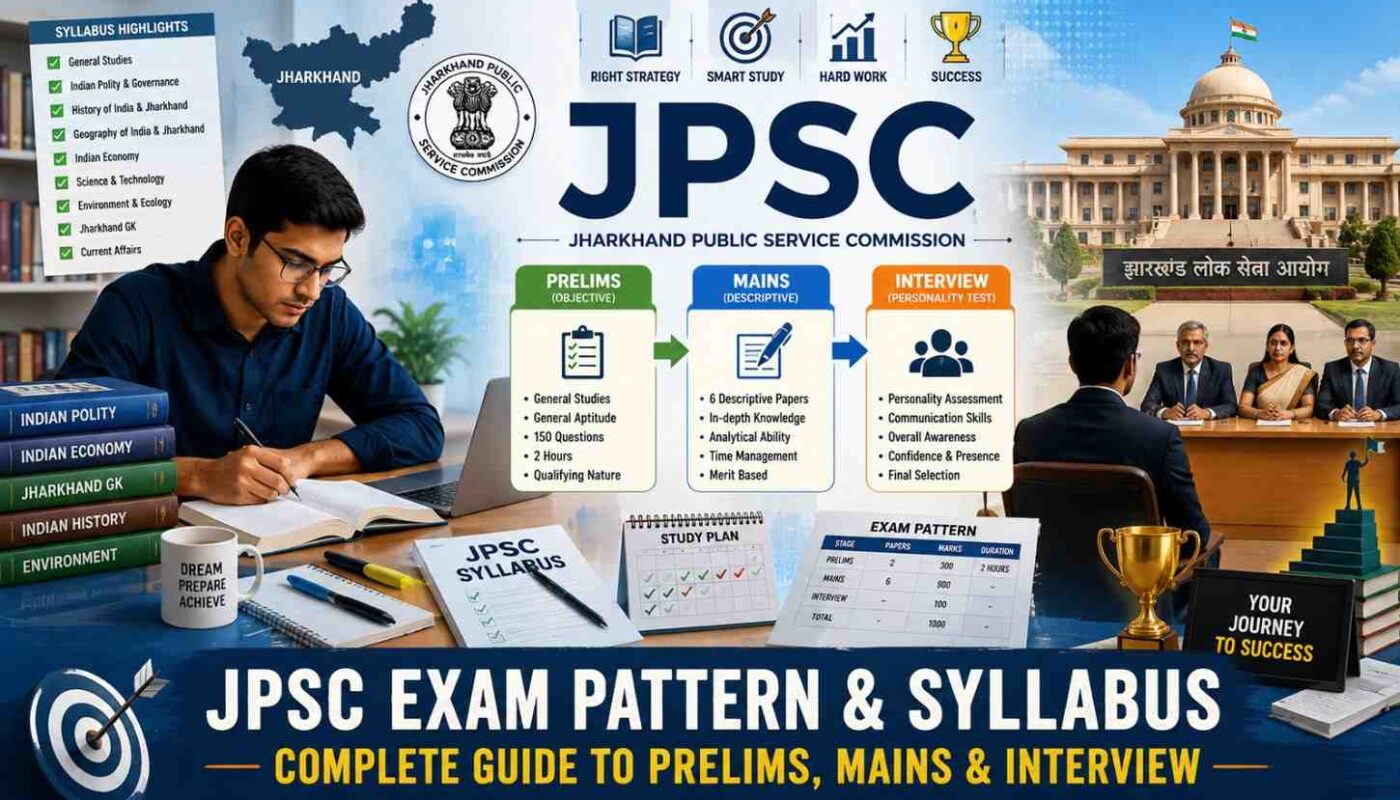
JPSC follows a three-stage selection process, similar in spirit to the UPSC Civil Services Examination but with some important differences in how marks are counted.
- Preliminary Examination – objective type, used only to screen candidates for Mains
- Main Examination – descriptive, and the stage where your actual rank is decided
- Interview (Personality Test) – the final stage before the merit list is prepared
The detail that trips up many first-time aspirants is this: your Prelims score is not added to your final merit. Prelims is purely qualifying – clear the cutoff, and you move on with a clean slate. Everything that determines your rank comes from Mains (950 marks) plus the Interview (100 marks), for a final total of 1,050 marks. This is a meaningful structural difference from some other state PCS exams, and it changes how you should allocate study time – Prelims gets you through the door, but Mains is where the exam is actually won.
JPSC Prelims Exam Pattern
The Preliminary Examination consists of two compulsory papers, both objective type (MCQ-based), and both compulsory – there’s no choice of optional subjects at this stage.
| Paper | Number of Questions | Marks | Duration |
| General Studies – I | 100 | 200 | 2 hours |
| General Studies – II (Jharkhand-specific) | 100 | 200 | 2 hours |
| Total | 200 | 400 | 4 hours |
Key points to keep in mind about the Prelims pattern:
- No negative marking. Unlike UPSC, JPSC does not deduct marks for wrong answers, so attempting every question is generally the safer strategy.
- Marks here are not counted toward final selection. You only need to clear the qualifying cutoff (which is decided based on category-wise vacancies and competition each year) to advance to Mains.
- Both papers are held on the same day, in separate sessions, typically with General Studies I in the morning and General Studies II in the afternoon.
- Paper II carries disproportionate strategic weight even though it’s only “qualifying” – because it is entirely about Jharkhand, it rewards candidates who’ve put in dedicated state-specific preparation rather than general awareness alone.
JPSC Prelims Syllabus
Paper I: General Studies – I
This paper tests broad general awareness and reasoning across national and international subjects, alongside a Jharkhand-specific segment.
| Subject Area | Approx. Weightage | Key Topics |
| History of India | 15 questions | Ancient, Medieval, and Modern India |
| Geography of India | 10 questions | General, Physical, Economic, Social & Demographic Geography |
| Indian Polity and Governance | 10 questions | Constitution, Public Administration, Panchayati Raj |
| Indian Economy and Sustainable Development | 10 questions | Basic economic features, sustainable development, reforms and globalization |
| Science and Technology | 15 questions | General Science, Agricultural Technology, ICT |
| Jharkhand-Specific General Awareness | 10 questions | History, Society, Culture, Heritage of Jharkhand |
| National and International Current Affairs | 15 questions | Current events of national/global relevance |
| General Miscellaneous Topics | 15 questions | Human Rights, Environment & Biodiversity, Urbanization, Sports, Disaster Management, Poverty & Unemployment, Awards, International Organizations |
Paper II: General Studies – II (Jharkhand Special)
This is the paper that genuinely separates JPSC from other competitive exams. It is built almost entirely around Jharkhand’s history, governance, land laws, and ecology, and demands focused regional study that generic UPSC or other-state preparation simply won’t cover.
| Subject Area | Key Topics |
| History of Jharkhand | Munda, Nagavanshi, Manjhi-Pargana, and other traditional tribal governance systems |
| Jharkhand Movement | Tribal freedom fighters, the statehood movement, key leaders (“Vibhuti”) of the region |
| Distinctive Identity of Jharkhand | Social, cultural, political, economic, and religious character of the state |
| Tribal Culture, Folk Arts, and Literature | Folk dance, music, literature, and writers of Jharkhand |
| Land Laws of Jharkhand | Chotanagpur Tenancy Act (CNT), Santhal Pargana Tenancy Act (SPT) – frequently tested in detail |
| Geography and Resources of Jharkhand | Forests, rivers, mountains, mineral resources, Damodar and Subarnarekha valley projects |
| Industrial and Development Policy | Industrial policy, displacement and resettlement policy, major schemes |
| Environment and Disaster Management | Forest and wildlife conservation, environmental issues, disaster preparedness in the state |
| Current Affairs of Jharkhand | Recent developments specific to the state |
Practical tip: Because Paper II is entirely state-specific, it’s the section where consistent, targeted study (rather than broad current-affairs reading) yields the highest return. Candidates who treat it as an afterthought to “general” Paper I preparation tend to underperform here.
JPSC Mains Exam Pattern
Once you clear Prelims, the Main Examination is where your actual score is built. It consists of six papers, all descriptive in nature, each of three hours’ duration.
| Paper | Subject | Marks | Nature |
| Paper 1 | General Hindi (50) + General English (50) | 100 | Qualifying only |
| Paper 2 | Language and Literature (choice of regional language) | 150 | Counted in merit |
| Paper 3 | Social Sciences – History and Geography | 200 | Counted in merit |
| Paper 4 | Indian Constitution, Polity, Public Administration & Good Governance | 200 | Counted in merit |
| Paper 5 | Indian Economy, Globalization & Sustainable Development | 200 | Counted in merit |
| Paper 6 | General Science, Environment & Technology Development | 200 | Counted in merit |
| Total | 950 |
A few rules that matter for strategy:
- Paper 1 is qualifying only. You need a minimum qualifying score (commonly cited as around 30 marks) to clear it, but it does not add to your final merit. Don’t ignore it, but don’t over-invest time relative to Papers 2–6 either.
- Papers 2 through 6 decide your rank. These 750 marks, combined with the Interview, make up your full final score.
- There is no optional subject in JPSC Mains – every candidate writes the same six papers, which keeps the playing field level compared to exams with optional-subject choices.
JPSC Mains Syllabus
Paper 1 – General Hindi and General English (Qualifying)
Tests basic language proficiency through essay writing, grammar, comprehension, and précis writing in both Hindi and English.
Paper 2 – Language and Literature
Candidates choose one language from a list that reflects Jharkhand’s linguistic diversity, including Hindi, English, Sanskrit, Urdu, Bengali, Oriya, and several tribal and regional languages – Santhali, Mundari, Ho, Kurux, Kurmali, Khortha, Khadia, Panchpargania, and Nagpuri among them. This breadth is one of JPSC’s distinguishing features and reflects the state’s tribal and linguistic heritage.
Paper 3 – Social Sciences (History & Geography)
This paper is split into two roughly equal halves:
History covers the standard Ancient–Medieval–Modern arc of Indian history (the Indus Valley Civilization through to Independence and its aftermath), but with a dedicated section on the History of Jharkhand – including the Sarna/Adi-dharma tribal belief system, the Birsa Munda and Tana Bhagat movements, and the broader freedom struggle as it played out in the region.
Geography spans physical geography fundamentals (plate tectonics, climate systems, landform evolution), the physical and human geography of India, and a focused section on the Geography of Jharkhand – its mineral wealth, river valley projects, tribal population patterns, and resource utilization.
Paper 4 – Indian Constitution, Polity, Public Administration & Good Governance
Covers constitutional fundamentals (Preamble, Fundamental Rights and Duties, Directive Principles), the structure of Union and State governments, Centre-State relations, and special provisions for Scheduled Areas – relevant given Jharkhand’s large tribal population. The Public Administration portion covers civil service structures, bureaucracy, decentralization, disaster management, and good-governance mechanisms like the Right to Information Act and Lokayukta.
Paper 5 – Indian Economy, Globalization & Sustainable Development
Covers national income concepts, inflation, public finance, banking, and trade at the national level, alongside sustainable development indicators and poverty/unemployment measurement. It closes with a dedicated section on the economy of Jharkhand – its sectoral composition, demographic profile, and development challenges around poverty, land, and forest resources.
Paper 6 – General Science, Environment & Technology Development
A broad paper spanning physical and life sciences, environmental science (biodiversity hotspots, pollution, environmental law), and science & technology policy (space, nuclear, and IT/cybersecurity developments in India). It also includes an agriculture science component specific to Jharkhand’s agro-climatic zones, crop diversification, and soil management – relevant to a state where agriculture remains central to the rural economy.
JPSC Interview (Personality Test)
Candidates who clear the Mains cutoff are called for the Interview, the final stage of selection, carrying 100 marks. Unlike the written papers, this is conducted in person before a board.
The Interview isn’t a test of subject knowledge you’ve already proven in Mains – it’s an assessment of your suitability for public administration: how you communicate, handle pressure, reason through unfamiliar situations, and demonstrate awareness of current affairs both within Jharkhand and nationally. Candidates are generally advised to stay updated on recent developments in the state (government schemes, major projects, local issues) since these come up frequently.
Final Merit Calculation
| Stage | Marks Counted Toward Merit |
| Prelims | Not counted (qualifying only) |
| Mains (Papers 2–6) | 750 |
| Interview | 100 |
| Final Merit Total | 850–1,050 depending on how cutoffs and Paper 1 qualifying marks are treated in a given cycle |
Note: Candidates should always verify the exact final merit composition against the specific advertisement notification for the cycle they’re applying under, as JPSC occasionally issues clarifications on weightage.
Frequently Asked Questions
No. JPSC does not apply negative marking in the Preliminary Examination, which is a point of relief for many aspirants compared to UPSC.
No. Prelims is purely a screening stage. Only Mains and Interview marks are added for the final merit list.
No. All candidates attempt the same six papers – there is no optional subject choice, unlike UPSC.
Generally yes, provided they can furnish proof of having passed before the date specified in the relevant notification (commonly before the Mains application stage or Interview). Always confirm this against the specific year’s advertisement.
As per the Combined Civil Services Examination 2025 notification (Advt. No. 01/2026), the general age limit is 21 to 35 years, with relaxations available for reserved categories, women candidates, and PwBD candidates as per Jharkhand government rules. Age limits can change slightly between notifications, so cross-check the current one before applying.
A Note on Using This Guide
Exam patterns and syllabi for state PSC exams are revised periodically, and JPSC has, in past cycles, made adjustments to paper structure and marking schemes. This article reflects the structure as notified for the 2025-26 examination cycle. Before finalizing your preparation plan, it’s good practice to cross-verify current details – exam dates, vacancy numbers, and any syllabus tweaks – directly against the official notification PDF on jpsc.gov.in, since that remains the only authoritative source for binding exam rules.
This article is intended as a study reference for JPSC aspirants and is based on publicly available JPSC notifications. It is not a substitute for the official examination notification, which should always be consulted for final confirmation of exam dates, eligibility, and syllabus.
Also Try This
All State PSC Exams 2027: State-Wise List, Eligibility & Preparation



2 thoughts on “JPSC Exam Pattern and Syllabus 2026: Complete Guide to Prelims, Mains, and Interview”