 by
by The Bihar Public Service Commission (BPSC) runs one of the most closely watched recruitment drives in eastern India, filling Group A and Group B posts such as Sub-Divisional Officer, Block Development Officer, District Revenue Officer, and other administrative roles under the Bihar government. With the 72nd Combined Competitive Examination (CCE) notification out – 1,230 vacancies announced on 5 May 2026 and Prelims scheduled for 26 July 2026 – getting the exam pattern and syllabus right matters more than ever, especially since BPSC has changed its scoring structure twice in the last three cycles.
This guide walks through the current three-stage selection process, the exact marking scheme for each stage, the full Prelims and Mains syllabus, and the structural changes that older study material often gets wrong.
How the BPSC Selection Process Works
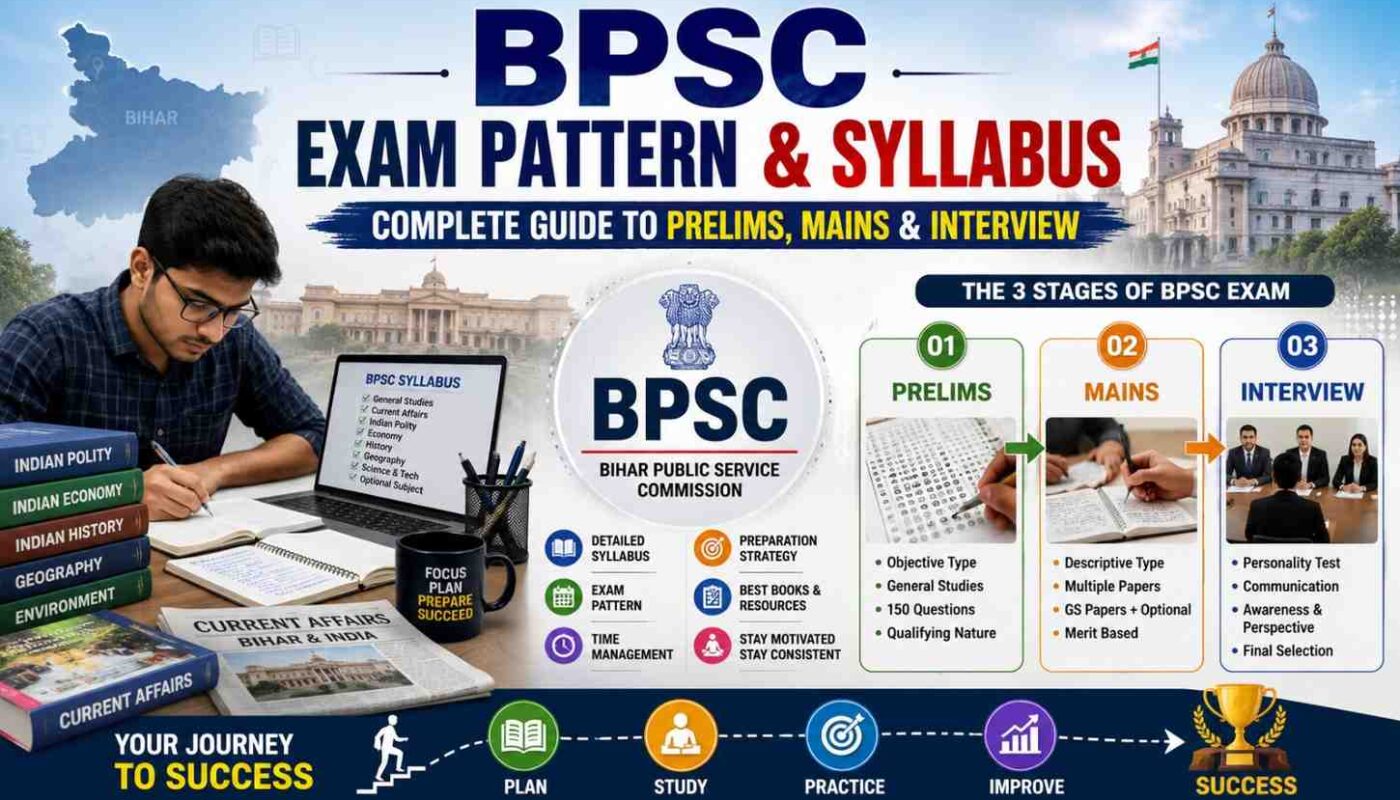
BPSC selects candidates through three stages, and only your performance in the last two actually counts toward your final rank:
- Prelims – Objective (MCQ), qualifying only
- Mains – Descriptive plus one objective qualifying paper, counts toward merit
- Interview – Personality test, counts toward merit
This is the same broad structure UPSC and most state PCS commissions follow, but BPSC’s marks distribution has its own quirks – particularly around which Mains papers actually feed into your rank.
BPSC Exam Pattern at a Glance
| Stage | Nature | Marks | Duration |
| Prelims | Objective (qualifying) | 150 | 2 hours |
| Mains – General Hindi | Descriptive (qualifying) | 100 | 3 hours |
| Mains – GS Paper I | Descriptive (counts to merit) | 300 | 3 hours |
| Mains – GS Paper II | Descriptive (counts to merit) | 300 | 3 hours |
| Mains – Essay | Descriptive (counts to merit) | 300 | 3 hours |
| Mains – Optional Subject | Objective (qualifying) | 300 | 3 hours |
| Interview | Personality test | 120 | – |
Final merit = GS Paper I + GS Paper II + Essay + Interview = 1,020 marks. General Hindi and the Optional Subject are qualifying hurdles you must clear, but neither adds a single mark to your rank.
This is one of the most misunderstood parts of the current pattern. Many aspirants still prepare the Optional Subject as if it were merit-bearing, the way it used to be – it isn’t anymore.
BPSC Prelims Exam Pattern
| Detail | Specification |
| Paper | Single paper – General Studies |
| Total marks | 150 |
| Number of questions | 150 |
| Mode | Offline (OMR-based) |
| Duration | 2 hours |
| Question type | Objective (MCQ) |
| Negative marking | 1/3 mark deducted per wrong answer |
Negative marking is back, and it changes your test-day strategy. BPSC reintroduced 1/3rd negative marking in the Prelims from recent cycles after a period without it, and it remains in effect for the 72nd CCE. The Commission has also added a fifth OMR option, “E,” meant to be marked when you deliberately choose not to attempt a question – leaving a row completely blank still costs you 1/3 mark, the same as a wrong answer. In practice, this means wild guessing on questions where you can’t eliminate any options is no longer free; it’s a real risk to your score, while educated guesses after eliminating one or two options remain worthwhile.
BPSC Prelims Syllabus
General Science General awareness of science as encountered in everyday life and observation. Questions don’t assume subject specialization, so this is more about reasoning through basic scientific concepts than recalling textbook formulas.
Current Affairs Events of national and international importance, with a noticeably heavier weight given to developments within Bihar specifically.
History History of India with particular emphasis on Bihar – covering the broad sweep of Indian history while expecting deeper familiarity with Bihar’s historical trajectory.
Geography Physical, social, and economic geography of India, including major agricultural belts and natural resources, alongside Bihar’s own geography – its river systems and geographical sub-divisions in particular.
Polity India’s political system, Panchayati Raj, and community development and planning, viewed through both a national and a Bihar-specific lens.
Economy The Indian economy generally, with focused attention on how Bihar’s economy has evolved since independence.
Indian National Movement The nature and growth of 19th-century nationalism and the path to independence, with Bihar’s contribution – the Champaran Satyagraha, the 1857 revolt’s reach into Bihar, the Santhal uprising, the Birsa Munda movement, and the Quit India Movement of 1942 – treated as a core, examinable thread rather than a footnote.
General Mental Ability Basic reasoning and aptitude questions, generally drawing on matriculation or intermediate-level mathematics rather than advanced quantitative skills.
BPSC Mains Exam Pattern
Only candidates who clear the Prelims cut-off move to Mains, and because Prelims marks are discarded entirely at that point, your Mains and Interview performance is what actually determines your final rank.
The Mains exam consists of five papers:
- General Hindi (qualifying)
- General Studies Paper I (merit)
- General Studies Paper II (merit)
- Essay (merit)
- Optional Subject (qualifying)
A few structural points worth flagging clearly, since this is where most older guides go stale:
- The Essay paper now carries full merit weight – 300 marks that go directly into your final rank. It was added to the Mains lineup specifically to address concerns about how the Optional Subject was being scaled and normalized across different subjects, and aspirants who treat it as an afterthought tend to lose ground here that’s hard to recover later.
- The Optional Subject is now an objective (MCQ) paper and purely qualifying – it carries 300 marks but none of them count toward merit. You only need to clear the minimum qualifying threshold.
- Each paper runs for 3 hours and is descriptive except for the Optional paper.
- Candidates choose their optional subject from a list of 34 disciplines at the time of filling the application form.
BPSC Mains Syllabus
| Paper | Core Topics |
| General Hindi | Essay (निबंध), Grammar (व्याकरण), Syntax (वाक्य विन्यास), Précis/Summarisation (संक्षेपण) |
| GS Paper I | Indian culture, modern history of India and Bihar, current national and international events, statistical interpretation (graphs and data analysis) |
| GS Paper II | Indian polity, Indian economy, geography of India, role of science and technology in India’s and Bihar’s development |
| Essay | Moral and philosophical themes, hypothetical/abstract topics, social-economic-political-administrative issues, self-reliant India and Digital India, Bihar-specific problems and possibilities, popular Bihar proverbs and sayings |
| Optional Subject | One subject chosen from 34 options, including History, Geography, Public Administration, Political Science, Sociology, Psychology, Economics, Commerce, Law, Mathematics, Statistics, Botany, Zoology, Chemistry, Physics, Agriculture, Anthropology, Philosophy, Management, and several language-literature options (Hindi, English, Urdu, Sanskrit, Maithili, Bengali, Persian, Arabic, Pali) |
GS Paper I in Detail
- Modern history of India, with Bihar’s specific trajectory from roughly the mid-19th century onward
- Growth of Western and technical education in Bihar
- Bihar’s role in India’s freedom struggle, including the Santhal uprising, the 1857 revolt, the Birsa Movement, the Champaran Satyagraha, and the Quit India Movement
- Key features of Mauryan and Pala-era art, and Patna Kalam (Qalam) painting
- Foundational knowledge of figures like Mahatma Gandhi, Rabindranath Tagore, and Jawaharlal Nehru
- Statistical analysis questions that test your ability to draw sound inferences from data, graphs, and diagrams – and to spot contradictions or limitations within them
GS Paper II in Detail
- Indian Polity: The political system of India, examined alongside Bihar’s own political structures
- Indian Economy: Planning processes in India
- Geography of India: Physical, economic, and social geography, with a clear tilt toward Bihar-specific geography
- Science and Technology: How scientific and technological progress has shaped development in India and Bihar, with particular attention to applied, real-world impact rather than theoretical depth
BPSC Essay Paper: What to Expect
The Essay paper is structured in three thematic sections, each worth 100 marks, for a total of 300 marks across the paper.
- Twelve essay topics are given in total, spread across the three sections
- Candidates must attempt three essays – one from each section
- Each essay should run roughly 700–800 words
Given that this paper now feeds directly into your merit score, regular timed writing practice – not just reading widely – makes a measurable difference to your final rank.
BPSC Interview (Personality Test)
Candidates who clear the Mains move to the Interview, conducted by a board appointed by the Commission.
- The board has access to your career record and the interests you declared in your application form, and the conversation is built around that personal record
- The goal is to assess your suitability for a career in Bihar’s state services – not to re-test subject knowledge
- Beyond academics, candidates are expected to stay current on developments both within Bihar and at the national level
- It functions more as a structured conversation meant to probe analytical ability and clarity of thought than as a formal cross-examination
Frequently Asked Questions
Yes. 1/3 mark is deducted for each incorrect answer, and the same deduction now applies if you leave a question completely blank instead of marking the “not attempted” option on the OMR sheet.
No. The Optional Subject is now an objective paper and is purely qualifying – you need to clear the minimum cutoff, but the marks themselves aren’t added to your merit score.
900 marks, made up of GS Paper I (300), GS Paper II (300), and the Essay (300). Add the Interview’s 120 marks, and the total final merit works out to 1,020.
34 subjects are on the list, ranging from humanities and social sciences to languages, pure sciences, and engineering disciplines. You declare your choice at the time of applying.
Largely yes – the broad subject areas (General Science, History, Geography, Polity, Economy, Current Affairs, and the National Movement) have stayed consistent across recent cycles, though the Commission periodically refines the marking scheme and OMR format, as it has with the 1/3 negative marking and the new “not attempted” option.
This guide reflects the BPSC 72nd CCE pattern as per the notification dated 5 May 2026. Candidates should always cross-check final details against the official notification and syllabus PDF published at bpsc.bihar.gov.in, since the Commission can issue corrigenda after the initial release.
Also Try This
All State PSC Exams 2027: State-Wise List, Eligibility & Preparation



One thought on “BPSC Exam Pattern and Syllabus 2026: Complete Guide to Prelims, Mains, and Interview”