 by
by The Rajasthan Public Service Commission (RPSC) has released the RAS/RTS Combined Competitive Exam 2026 notification on 27 May 2026, announcing 607 vacancies across Rajasthan State Services and Rajasthan Subordinate Services (192 State Service posts and 415 Subordinate Service posts). Online applications opened on 4 June 2026 and will close on 3 July 2026, with the RAS Prelims Exam scheduled for Sunday, 29 November 2026.
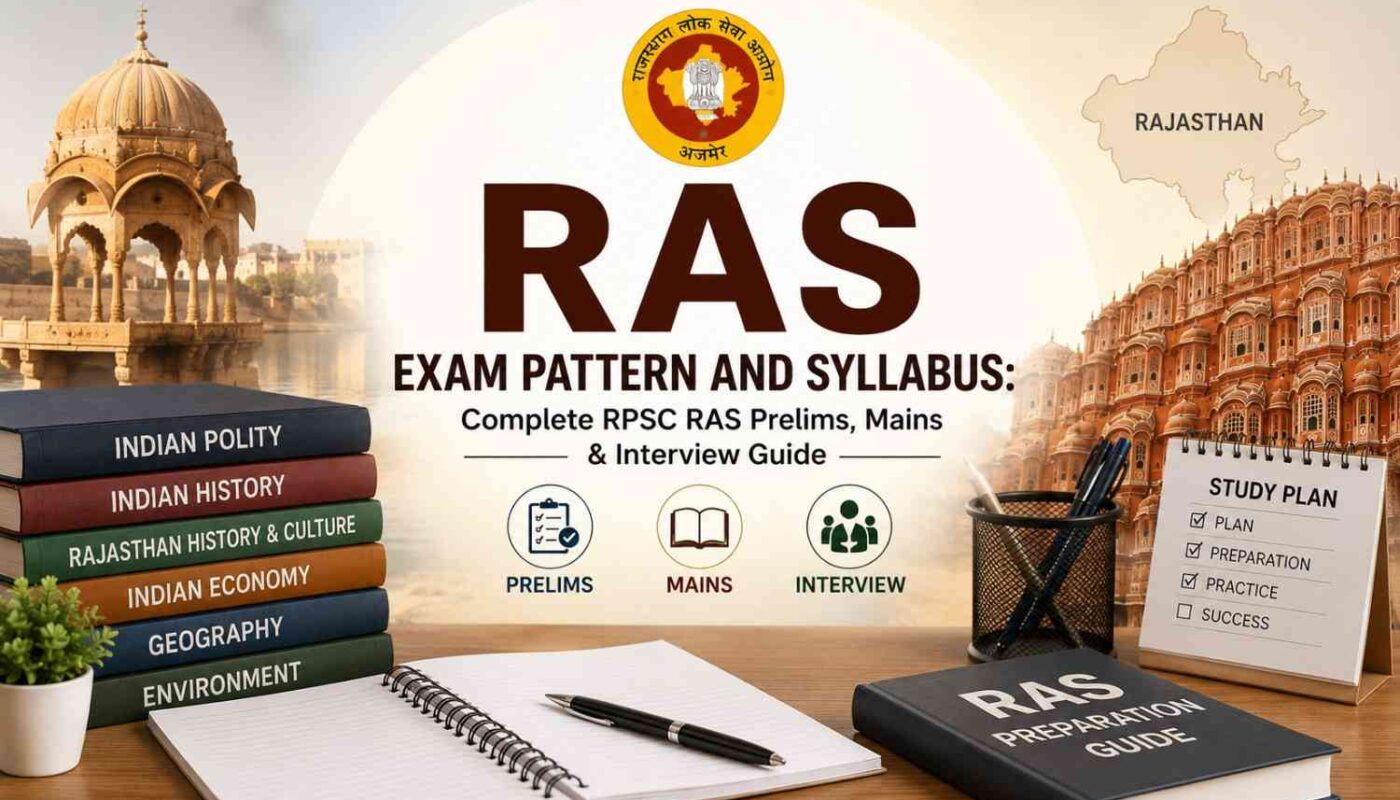
For anyone aiming to become a Rajasthan Administrative Service (RAS) or Rajasthan Police Service (RPS) officer, understanding the exact exam pattern and syllabus is the single most important first step. This guide breaks down every stage of the RPSC RAS examination — Prelims, Mains, and Interview — along with the marking scheme, paper-wise topics, and the latest changes candidates should know about before they start preparing.
What is the RAS Exam?
The RAS exam, officially called the Rajasthan State and Subordinate Services Combined Competitive Examination, is conducted annually by RPSC to recruit officers for administrative, police, and other allied state services in Rajasthan. It is widely regarded as the most prestigious state-level civil services exam in Rajasthan, comparable in stature to the UPSC Civil Services Examination but focused heavily on Rajasthan-specific history, culture, governance, and current affairs.
RAS 2026 Selection Process: Three Stages
RPSC selects candidates through a three-stage process:
- Preliminary Examination – a single objective-type paper used purely for screening.
- Main Examination – four descriptive papers that determine the final merit.
- Personality Test (Interview) – the concluding stage assessing administrative aptitude.
Only candidates who clear the Prelims move to the Mains, and only those who clear the Mains are called for the Interview. Marks scored in the Prelims are never added to the final merit list — they are used solely to shortlist candidates for the Mains.
RAS Exam Pattern at a Glance
| Exam Stage | Paper Type / Duration | Maximum Marks |
|---|---|---|
| RAS Prelims | General Studies – Objective (3 hours) | 200 |
| RAS Mains – Paper I | General Studies-I (3 hours) | 200 |
| RAS Mains – Paper II | General Studies-II (3 hours) | 200 |
| RAS Mains – Paper III | General Studies-III (3 hours) | 200 |
| RAS Mains – Paper IV | General Hindi & General English (3 hours) | 200 |
| RAS Interview | Personality Test | 100 |
The Mains examination alone carries 800 marks across four papers, and combined with the 100-mark interview, the final selection is based on a total of 900 marks.
RAS Prelims Exam Pattern 2026
- The Prelims paper is a single General Knowledge & General Science paper carrying 200 marks.
- It consists of 150 multiple-choice questions (MCQs), all carrying equal marks.
- Negative marking applies: one-third (1/3) mark is deducted for every wrong answer.
- Duration of the paper is 3 hours.
- It is purely a qualifying/screening stage — Prelims marks are not added to the final merit list.
| Subject | Questions | Marks | Negative Marking | Duration |
|---|---|---|---|---|
| General Knowledge & General Science | 150 | 200 | 1/3 mark per wrong answer | 3 Hours |
RAS Prelims Syllabus 2026
The Prelims paper draws questions from the following broad areas:
1. History, Art, Culture, Literature, Tradition and Heritage of Rajasthan Covers prehistoric sites from the Paleolithic to Bronze Age, sources of Rajasthan’s history (archaeological, epigraphical, literary, numismatic), major dynasties and their administrative systems, 18th–20th century peasant and Praja Mandal movements, integration of Rajasthan, architecture (forts, palaces, temples), painting styles, folk music and dance, Rajasthani dialects and literature, religious communities and saints, fairs, festivals, customs, and eminent personalities.
2. History of India Spans the Indus Valley and Vedic Age, Buddhist and Jain philosophy, major ancient and medieval dynasties (Mauryas, Guptas, Cholas, Vijayanagara, Mughals, Marathas), Bhakti-Sufi movements, the Revolt of 1857, the national movement, and post-independence nation-building up to 2000, including state reorganisation and the Nehruvian era.
3. World and Indian Geography (with special focus on Rajasthan) Includes physical features, climate, rivers, agriculture, minerals, population trends, urbanisation, biodiversity, soil types, and tourism — with a dedicated, exam-heavy section on Rajasthan’s own geography.
4. Indian Constitution, Political System and Governance Covers the framing of the Constitution, Fundamental Rights and Duties, Centre-State relations, constitutional bodies (Election Commission, UPSC, NHRC, NITI Aayog), the Lokpal and CVC, as well as Rajasthan’s own political and administrative machinery — Governor, Chief Secretary, District Collector, RPSC, Lokayukta, and Panchayati Raj.
5. Economic Concepts, Indian Economy and Economy of Rajasthan Growth and development indicators, HDI, fiscal and monetary policy, agricultural and industrial reforms, the latest Union Budget, and Rajasthan-specific topics such as State Budget, rural development, and major state welfare schemes.
6. Science and Technology Daily-life science, ICT, defence and space technology, biotechnology, genetic engineering, public health, and Rajasthan/India-specific S&T policies and achievements.
7. Logical Reasoning and Mental Ability Statement-assumption/argument/conclusion type reasoning, number/letter series, coding-decoding, seating arrangements, ratio-proportion, percentage, simple/compound interest, data interpretation, and probability.
8. Current Events and Issues (with special reference to Rajasthan) Important personalities, new government schemes, major economic and political developments, sports achievements, awards, and — notably — the Rajasthan Public Examination (Measures for Prevention of Unfair Means in Recruitment) Act, 2022, which candidates are specifically expected to know.
RAS Mains Exam Pattern 2026
RPSC admits 15 times the number of estimated vacancies to the Mains exam (with all tied candidates at the cut-off also admitted). The Mains consists of four compulsory descriptive/analytical papers featuring short, medium, and long-answer questions. General Hindi and General English are evaluated at the Senior Secondary level. Every paper runs for 3 hours.
| Paper | Subject | Maximum Marks | Duration |
|---|---|---|---|
| I | General Studies-I | 200 | 3 Hours |
| II | General Studies-II | 200 | 3 Hours |
| III | General Studies-III | 200 | 3 Hours |
| IV | General Hindi & General English | 200 | 3 Hours |
| Total | 800 | 12 Hours |
RAS Mains Syllabus – Paper-wise Breakdown
Paper I – History, Economy, and Sociology/Management/Accounting
- Unit I (History): Rajasthan’s history, art and heritage; Indian history and culture from the Indus Civilisation onward; modern world history up to 1991, including the World Wars and the Cold War.
- Unit II (Economy): Indian economic growth, agriculture, industrial policy, public finance, banking reforms, the global economy (WTO, World Bank, IMF), and a detailed section on Rajasthan’s economy — GSDP, the state’s “Developed Rajasthan 2047” vision, green growth, and SDG progress.
- Unit III (Sociology, Management, Accounting & Auditing): Caste and class dynamics, social challenges, general/HR/strategic management concepts, and accounting standards including GST basics and auditing principles.
Paper II – Ethics, Science & Technology, and Earth Sciences
- Unit I (Administrative Ethics): Human values, moral philosophy (Rta, Rin, Karma), the Bhagavad Gita’s ethical teachings, Gandhian ethics, and — a notably modern addition — the role of artificial intelligence versus human conscience in administrative decision-making.
- Unit II (Science & Technology): Chemistry, physics, biology, and human physiology in daily life, alongside contemporary technology topics such as AI and machine learning, blockchain, the Internet of Things, CRISPR, mRNA technology, cybersecurity, and India’s space and defence programmes.
- Unit III (Earth Sciences): World, Indian, and Rajasthan geography, including a new focus on UNESCO Geopark and Geoheritage Site potential in Rajasthan.
Paper III – Polity, Public Administration, Behaviour and Law
- Unit I: Indian Constitution and governance, Indian political dynamics including AI-enabled political mobilisation, Rajasthan’s state politics, and India’s foreign policy engagement with forums like the UN, G-20, QUAD, I2U2, AUKUS, and BRICS, plus India’s climate diplomacy through COP summits and Mission LiFE.
- Unit II: Theories of public administration, Union and state administrative institutions, comparative administration (USA, UK, France, China), and district administration.
- Unit III: Workplace behaviour and emotional intelligence, plus a Law section covering the RTI Act 2005, IT Act 2000, the new Bharatiya Nyaya Sanhita and Bharatiya Nagarik Suraksha Sanhita (replacing the IPC and CrPC), and key Rajasthan land laws such as the Rajasthan Tenancy Act 1955 and the Rajasthan Land Revenue Act 1956.
Paper IV – General Hindi and General English (Total: 200 marks, including a 40-mark Essay)
- General Hindi (90 marks): Grammar, idioms, précis writing, translation, and official letter/draft writing.
- General English (70 marks): Grammar and usage, comprehension and précis writing, translation, and composition/letter writing.
- Essay (40 marks): A roughly 600-word essay in Hindi or English, chosen from six broad themes — language and culture; society and governance; science, technology, and sustainability; economy and industry; current events and disasters; and Rajasthan tourism and contemporary issues.
RAS Interview (Personality Test)
Candidates who clear the Mains are called for the Interview, worth 100 marks. There is no fixed syllabus for this stage — RPSC evaluates communication skills, general awareness, administrative aptitude, and, importantly, the candidate’s understanding of Rajasthani culture and current affairs. The final merit list is prepared by combining Mains marks (800) and Interview marks (100), making the total selection score 900 marks.
RAS 2026: Key Updates Candidates Must Know
- 607 total vacancies notified for 2026, split between 192 State Service and 415 Subordinate Service posts.
- Online applications: 4 June 2026 to 3 July 2026.
- Prelims exam date: 29 November 2026 (Sunday).
- Age limit: Minimum 21 years, maximum 40 years as on 1 January 2027, with standard reservation-based relaxations.
- Eligibility: A graduation degree in any discipline from a recognised university; final-year students should check the notification carefully, as the degree/marksheet is generally required before the Mains stage rather than at the time of application.
- The 2024 cycle’s final result was declared on 18 April 2026, selecting 2,492 candidates — a useful benchmark for understanding RPSC’s typical selection volume and timelines.
- The Paper II and Paper III syllabus now carries a distinctly contemporary flavour, with explicit references to artificial intelligence in governance, cybersecurity, digital currency, and emerging legal codes (BNS/BNSS replacing the IPC/CrPC) — a clear signal that RPSC is aligning the exam with current technological and legal developments rather than static, textbook-only content.
How to Use This Syllabus Effectively
A few practical pointers based on how the RAS pattern is structured:
- Start with the Rajasthan-specific sections first. History, geography, economy, and polity of Rajasthan appear in both Prelims and Mains, so mastering this portion gives you marks across multiple papers.
- Treat current affairs as a daily habit, not a last-minute revision topic, since both Prelims and Mains (Paper III) test recent developments, government schemes, and Rajasthan-specific news.
- Don’t ignore the Law and Ethics sections in Paper II and III — these are newer, denser additions (RTI Act, IT Act, Rajasthan land laws, BNS/BNSS) that many aspirants underprepare for, making them a good differentiator if studied well.
- Practice Hindi and English writing regularly, since Paper IV’s précis, translation, and letter-writing components are skill-based and improve only with consistent practice, not last-minute reading.
Frequently Asked Questions (FAQs)
No. The Prelims is only a qualifying stage used to shortlist candidates for the Mains; its marks are never added to the final merit list.
Four papers — General Studies I, II, and III, plus General Hindi and General English — totalling 800 marks.
900 marks: 800 from the four Mains papers plus 100 from the Interview.
Yes, one-third of the marks allotted to a question is deducted for every incorrect answer.
The RPSC RAS Prelims 2026 is scheduled for 29 November 2026.
RPSC has notified 607 vacancies for the 2026 cycle.
Disclaimer: Exam dates, vacancy figures, and syllabus details are subject to official RPSC notifications. Candidates should always cross-check the latest information on the official RPSC website (rpsc.rajasthan.gov.in) before finalising their preparation strategy.
Also Try This
All State PSC Exams 2027: State-Wise List, Eligibility & Preparation