 by
by The Chhattisgarh Public Service Commission (CGPSC) conducts the State Service Examination (SSE) every year to recruit officers for some of the most respected administrative posts in the state – Deputy Collector, Deputy Superintendent of Police (DSP), Naib Tehsildar, Assistant Director, and dozens of other Group A and Group B positions. For the 2025–26 recruitment cycle, CGPSC released its official notification on November 26, 2025, announcing 239 vacancies across various state services.
If you’re preparing for this exam, the single most important thing you can do before opening a single book is to understand exactly how the exam is structured and what it expects from you. This guide walks you through the complete CGPSC exam pattern and syllabus – updated with the latest 2026 exam cycle details – so you can build a preparation strategy that’s grounded in facts, not guesswork.
Quick Overview: CGPSC SSE 2026 at a Glance
| Detail | Information |
| Conducting Body | Chhattisgarh Public Service Commission (CGPSC) |
| Notification Released | November 26, 2025 |
| Total Vacancies (2025–26 cycle) | 239 posts |
| Prelims Exam Date | February 22, 2026 |
| Prelims Result Declared | March 25, 2026 |
| Mains Exam Dates | June 6–9, 2026 |
| Selection Stages | Prelims → Mains → Interview |
| Age Limit | 21–30 years (21–28 years for DSP) |
| Minimum Qualification | Bachelor’s degree from a recognized university |
| Official Website | psc.cg.gov.in |
Keep in mind that exact dates, vacancy numbers, and minor pattern tweaks can shift from one recruitment cycle to the next, so always cross-check the latest figures against the official CGPSC notification before you finalize your study plan.
What is the CGPSC Selection Process?
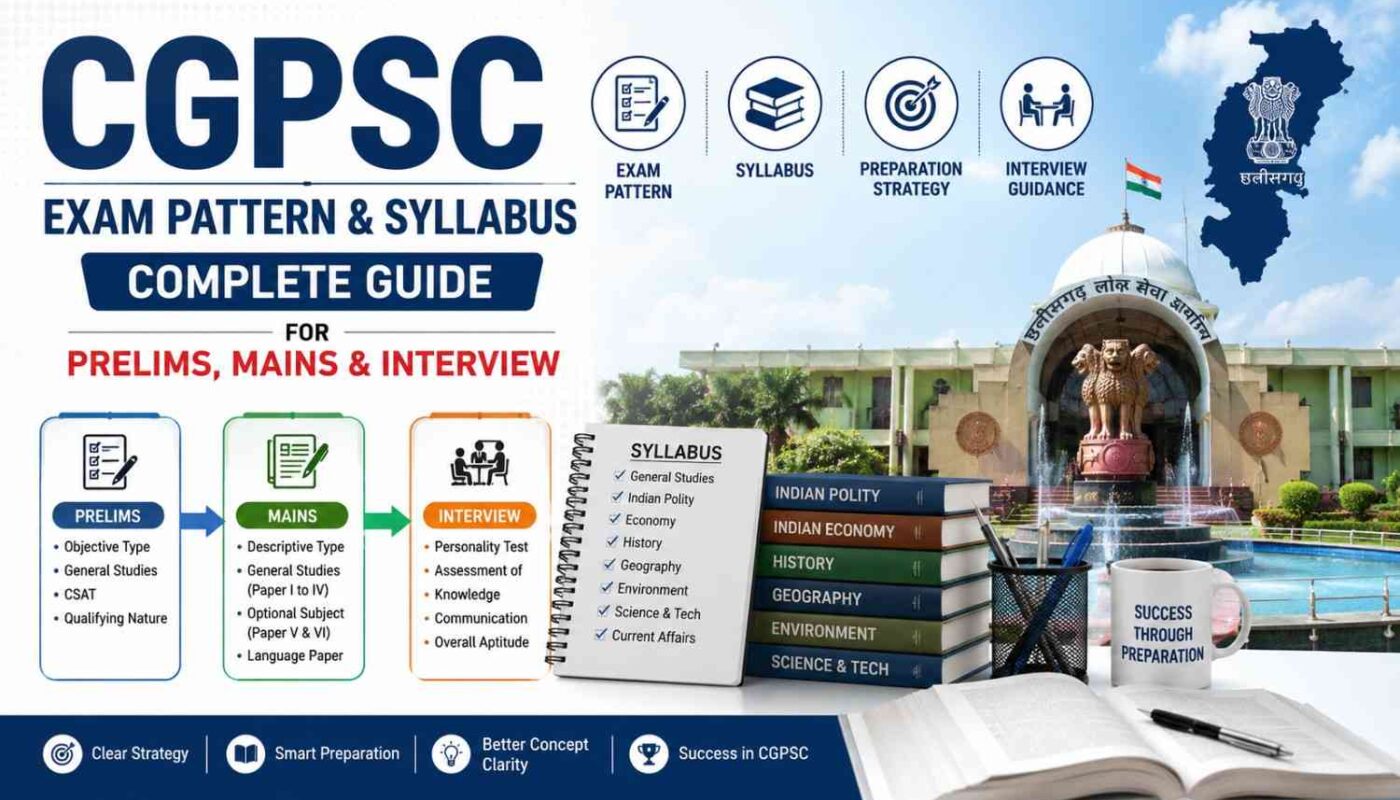
CGPSC follows a three-stage selection process, similar in spirit to the UPSC Civil Services Exam but tailored to Chhattisgarh’s administrative needs and regional knowledge requirements:
- Preliminary Examination – Two objective-type papers (screening stage only)
- Main Examination – Seven descriptive-type papers (this is where merit is actually decided)
- Interview / Personality Test – The final stage, worth 100 marks
A point many first-time aspirants miss: Prelims marks are NOT counted in your final merit. Prelims is purely a qualifying/screening round. Your actual rank depends entirely on how you perform in Mains plus the Interview. This single fact should shape how you allocate your study time – Mains preparation deserves the lion’s share of your effort, even while you’re still gearing up for Prelims.
CGPSC Exam Pattern 2026: Stage-by-Stage Breakdown
| Exam Stage | Papers / Duration | Total Marks |
| Prelims | Paper I: General Studies (2 hrs) + Paper II: General Aptitude Test (2 hrs) | 200 + 200 = 400 |
| Mains | 7 papers – Language, Essay, and General Studies I–V (3 hrs each) | 1400 |
| Interview | Personality Test | 100 |
CGPSC Prelims Exam Pattern
The Preliminary Examination has two compulsory objective-type papers, each carrying 200 marks and lasting 2 hours.
- Paper I – General Studies: 100 questions, 200 marks. This paper is the one that actually counts – your merit list for Mains eligibility is prepared based on Paper I scores only.
- Paper II – General Aptitude Test: 100 questions, 200 marks, but this paper is purely qualifying in nature. Marks scored here are not added to your merit list ranking.
- Negative Marking: One-third (⅓) of the marks allotted to a question is deducted for every wrong answer in both papers.
- Minimum Qualifying Marks: 33% for unreserved/general category candidates and 23% for reserved category candidates, in each paper.
| Paper | Subject | Questions | Marks | Duration | Negative Marking |
| Paper I | General Studies | 100 | 200 | 2 hours | ⅓ mark per wrong answer |
| Paper II | General Aptitude Test | 100 | 200 | 2 hours | ⅓ mark per wrong answer |
Practical tip: Because Paper II doesn’t count toward your merit ranking but you still must clear the minimum qualifying threshold, don’t over-invest prep time here at the cost of Paper I. Treat Paper II as a “clear it comfortably and move on” target rather than a scoring opportunity.
CGPSC Mains Exam Pattern
Mains is entirely descriptive and consists of seven papers, each worth 200 marks, for a total of 1400 marks. Every paper (except the Language paper) can be answered in either Hindi or English – but you must pick one language and stick with it for the entire paper; mixing languages mid-paper isn’t allowed.
| Paper | Subject | Duration | Marks |
| Paper I | Language (Hindi, English, Chhattisgarhi) | 3 hrs | 200 |
| Paper II | Essay | 3 hrs | 200 |
| Paper III | General Studies I | 3 hrs | 200 |
| Paper IV | General Studies II | 3 hrs | 200 |
| Paper V | General Studies III | 3 hrs | 200 |
| Paper VI | General Studies IV | 3 hrs | 200 |
| Paper VII | General Studies V | 3 hrs | 200 |
| Total | 1400 |
Mains papers are designed to test analytical depth, clarity of expression, and command over the subject – not rote memorization. Examiners reward structured, evidence-based answers over lengthy but unfocused ones.
CGPSC Interview (Personality Test)
Candidates who clear Mains move to the final stage: a 100-mark Personality Test. This isn’t a knowledge quiz – the board evaluates your communication ability, decision-making temperament, awareness of current affairs, ethical grounding, and overall suitability for a public administration role. Confidence, honesty in your answers, and a calm, balanced approach to tricky situational questions tend to matter more here than textbook facts.
CGPSC Syllabus 2026 – Prelims
Paper I: General Studies
Part A – National-Level General Studies
- History of India and the Indian National Movement
- Physical, Social, and Economic Geography of India
- Indian Polity and the Constitution of India
- Indian Economy
- General Science and Technology
- Indian Philosophy, Art, Literature, and Culture
- Current Affairs and Sports
- Environment and Ecology
Part B – Chhattisgarh-Specific General Knowledge
- History of Chhattisgarh and its contribution to the Freedom Movement
- Geography, climate, physical features, census data, archaeological sites, and tourist centres of Chhattisgarh
- Literature, music, dance, art, culture, idioms, proverbs, riddles, and folk singing traditions of Chhattisgarh
- Tribes, special traditions, festivals (including Teej), and customs of Chhattisgarh
- Economy, forests, and agriculture of Chhattisgarh
- Administrative structure, local self-government, and Panchayati Raj in Chhattisgarh
- Industry, energy, water resources, and mineral wealth of Chhattisgarh
- Current affairs specific to Chhattisgarh
Paper II: General Aptitude Test
- Interpersonal and communication skills
- Logical reasoning and analytical ability
- Decision-making and problem-solving
- General mental ability
- Basic numeracy and data interpretation (Class X level – numbers, magnitudes, charts, graphs, tables, data sufficiency)
- Knowledge of Hindi language (Class X level)
- Knowledge of Chhattisgarhi language
Note: Hindi and Chhattisgarhi language sections are tested directly in those languages – no English translation is provided, so candidates need genuine working familiarity with both.
CGPSC Syllabus 2026 – Mains
Paper I: Language
Part 1 – General Hindi: Comprehension, précis writing, synonyms and antonyms, homophones, one-word substitution, sandhi and sandhi-vichchhed, samaas, tatsam-tadbhav words, correction of words and sentences, prefixes and suffixes, idioms and proverbs, letter writing, periods in the history of Hindi literature, Chhattisgarh-based Hindi litterateurs and their works, unseen passages, official correspondence formats (notifications, circulars, reports), and translation between Hindi and English.
Part 2 – General English: Comprehension, précis writing, sentence correction and rearrangement, synonyms, antonyms, fill in the blanks, spelling correction, vocabulary and usage, idioms and phrases, tenses, prepositions, active-passive voice, and parts of speech.
Part 3 – Chhattisgarhi Language: Grammar, word formation, parts of speech, history and development of the Chhattisgarhi language and its literature, prominent Chhattisgarhi writers, the role of the Chhattisgarh Rajbhasha Commission, and the influence of media (newspapers, radio, cinema) on the language’s evolution.
Paper II: Essay
This paper has two parts, each requiring two essays of roughly 750 words (50 marks each):
- Part I – National and International Issues: Candidates choose two out of four given topics, addressing the reasoning, current status, supporting data, and possible solutions.
- Part II – Chhattisgarh State Issues: Same format, but focused on state-specific challenges and developments.
Paper III: General Studies I
- History of India: From the Indus Valley Civilization through the freedom struggle – covering the Vedic age, Buddhism and Jainism, Mauryan and Gupta empires, the Bhakti and Sufi movements, the rise and fall of regional kingdoms, colonial economic policies, the 1857 revolt, the growth of nationalism, Gandhian movements, and the eventual independence and partition of India.
- Constitution and Public Administration: Constitutional development, fundamental rights and duties, Directive Principles, the structure of the Union and State executive/legislature/judiciary, Centre-State relations, public administration theory, e-governance, RTI, Panchayati Raj, and the administrative structure of Chhattisgarh specifically.
- History of Chhattisgarh: From the prehistoric era through major regional dynasties (Kalachuris, Nalas, Sharabhpuriyas, and others), Maratha rule, princely states, the 1857 revolt’s regional impact, and the freedom movement as it played out in Chhattisgarh.
Paper IV: General Studies II
- General Science: Core chemistry (chemical equilibrium, metallurgy, organic compounds), physics (energy sources, optics, electricity), and biology (digestion, photosynthesis, respiration, the nervous and endocrine systems, reproduction, and genetics).
- Aptitude, Reasoning, and Mental Ability: Arithmetic operations, ratios, commercial mathematics, factorization, Vedic mathematics techniques, contributions of Indian mathematicians (Aryabhata, Brahmagupta, Bhaskaracharya, Ramanujan), data interpretation, probability, and standard reasoning question types (analogy, coding-decoding, series, assertion-reason, etc.)
- Applied and Behavioural Science: Role of IT in rural development, renewable and non-renewable energy, agricultural science and technology in India, biodiversity and its conservation, and environmental pollution and waste management.
Paper V: General Studies III
- Economics of India and Chhattisgarh: National and per-capita income, structural shifts in the economy, poverty and unemployment, monetary policy, banking reforms, public finance, and – with specific reference to Chhattisgarh – demographic patterns, women’s empowerment, rural development, and the state’s tax and debt structure.
- Geography of India: Physical features, drainage systems, climate, agriculture, mineral and energy resources, and industrial development at the national level.
- Geography of Chhattisgarh: The same themes – physical geography, demographics, agriculture, minerals, energy, and industry – examined specifically within the state’s context, including its forests, wildlife sanctuaries, and tourism potential.
Paper VI: General Studies IV
- Philosophy: Indian schools of thought (Vedanta, Samkhya, Yoga, Nyaya, Buddhist and Jain philosophy), Western philosophy (from Plato to Sartre), and applied ethics – including administrative ethics, corruption, and the role of whistle-blowers.
- Sociology: Core concepts (society, institution, social group), social stratification, social control and change, and research methodology in the social sciences.
- Social Aspects of Chhattisgarh: Tribal social organization, tribal development policy, folk arts and literature, major fairs and festivals, and protected archaeological and tourist sites within the state.
Paper VII: General Studies V
- Welfare, Development Programmes, and Law: Key social legislations (Domestic Violence Act, SC/ST Atrocities Act, RTI Act, Consumer Protection Act, IT Act, Prevention of Corruption Act), along with Chhattisgarh-specific welfare laws and government schemes.
- International and National Sports and Organisations: The UN system, IMF, World Bank, SAARC, BRICS, WTO, and major sporting events and bodies.
- Educational Institutions and Human Resource Development: UGC, AICTE, IITs, IIMs, NITs, and broader issues around skill development, employability, and inclusive education (including for girls and persons with disabilities).
CGPSC Eligibility Criteria 2026
Before diving into preparation, double-check that you actually qualify:
- Nationality: Must be a citizen of India.
- Educational Qualification: A bachelor’s degree from a recognized university. Final-year students can apply, but must complete their degree by the time specified in the notification (typically before the Mains stage).
- Age Limit: 21 to 30 years for most posts; 21 to 28 years specifically for the Deputy Superintendent of Police (DSP) post.
- Domicile-Based Relaxation: Permanent residents of Chhattisgarh get an extended upper age limit of up to 35 years; reserved category domicile candidates may get relaxation up to 40–45 years depending on the category.
- Attempts: There’s no cap on the number of attempts, as long as you remain within the prescribed age limit.
Since age relaxation rules can be fairly detailed and category-specific, it’s worth reading the exact relaxation table in the official notification PDF rather than relying on a generic summary.
How CGPSC Differs From UPSC: A Quick Comparison
Many aspirants prepare for CGPSC alongside UPSC or other state PCS exams, so it helps to know where the overlap ends:
- Regional weight: CGPSC dedicates an entire portion of Prelims Paper I and large sections across multiple Mains papers specifically to Chhattisgarh’s history, geography, culture, and current affairs – far more state-specific depth than UPSC requires.
- Language testing: CGPSC tests proficiency in Chhattisgarhi as a separate component, something no other PCS exam in India requires.
- No optional subject: Unlike UPSC Mains, CGPSC Mains has no optional subject paper – all seven papers are compulsory and largely GS-based.
- Mains-weighted merit: Since Prelims is purely qualifying, your real competitive edge is built in Mains and Interview, making consistent answer-writing practice non-negotiable from early in your preparation.
A Realistic Preparation Strategy for CGPSC 2026–27
- Start with the syllabus, not the books. Print or save the syllabus and tick off topics as you study – this prevents the common mistake of over-preparing static GK while neglecting Chhattisgarh-specific content that carries disproportionate weight.
- Build a Chhattisgarh-first current affairs habit. State-level news (government schemes, local administrative changes, cultural events, economic data) doesn’t show up reliably in national newspapers – you’ll need a source that tracks Chhattisgarh specifically.
- Practice answer writing from day one of Mains prep, not just in the final two months. Descriptive papers reward structured thinking, and that’s a skill built over months, not crammed overnight.
- Don’t neglect the Language and Essay papers. Together they’re worth 400 marks – as much as two GS papers combined – yet aspirants often under-prepare for them simply because they “feel” less technical.
- Treat the Aptitude paper (Prelims Paper II) as a hurdle to clear, not a score to maximize, since it doesn’t count toward merit once you’re past the qualifying threshold.
- Revisit the official notification before every cycle. Vacancy numbers, exact age cut-off dates, and minor pattern adjustments can change year to year – what you read here is accurate for the 2025–26 cycle, but always verify against psc.cg.gov.in closer to your own application window.
Frequently Asked Questions
Yes. In the Prelims stage, one-third of the marks allotted to a question is deducted for every incorrect answer, in both Paper I and Paper II.
No. Prelims is purely qualifying. Only Paper I (General Studies) marks decide your eligibility for Mains – Paper II (Aptitude) marks aren’t added to the merit list at all. Your final rank is based solely on your combined Mains and Interview score.
Seven papers, each worth 200 marks, totaling 1400 marks.
Generally 21 to 30 years, with the exception of the DSP post, which has an upper limit of 28 years. Chhattisgarh domicile candidates and reserved categories receive additional age relaxation.
Candidates can choose to write any paper (other than the Language paper) entirely in Hindi or entirely in English – but switching languages within a single paper is not permitted.
Does CGPSC syllabus change every year?
The core syllabus structure has remained largely stable across recent cycles, but always cross-check the latest official notification PDF, since the Commission can introduce minor topic-level revisions.
This article is intended as a study reference based on CGPSC’s publicly available exam pattern and syllabus information. For binding details on any particular recruitment cycle – including exact dates, vacancy breakup, and eligibility – always refer to the official notification at psc.cg.gov.in.
Also Try This
All State PSC Exams 2027: State-Wise List, Eligibility & Preparation



One thought on “CGPSC Exam Pattern and Syllabus 2026: Complete Guide for Prelims, Mains & Interview”