 by
by Choosing an optional subject is one of the most consequential decisions a UPSC Civil Services aspirant will make. It’s not a footnote in your preparation – it’s 500 marks (25% of your total Mains score) riding on a single choice made months, sometimes years, before the exam. Get it right, and it becomes your strongest scoring lever. Get it wrong, and it can quietly drag down an otherwise strong attempt.
This guide walks through the full list of 48 optional subjects UPSC currently allows, how the selection actually plays out in real toppers’ strategies, what the latest success-rate data shows, and a practical framework for picking a subject that fits you – not just what’s trending on YouTube. It’s written for candidates who will appear in the CSE 2027 cycle, whose notification is expected in January 2027.
UPSC CSE 2027: Where the Timeline Currently Stands
Before getting into subject selection, it helps to know exactly where you are in the exam cycle. As of July 2026:
- UPSC CSE 2026 is already underway – the Prelims were held on 24 May 2026, and the Mains examination begins on 21 August 2026. If you’re appearing in this cycle, your optional subject choice is already locked in via your Detailed Application Form (DAF).
- UPSC CSE 2027 notification is expected around mid-January 2027, based on the Commission’s published annual exam calendar, with the Preliminary Examination provisionally scheduled for 23 May 2027. The Mains would typically follow a few months later, around August 2027.
- This means aspirants targeting the 2027 cycle currently have roughly 10–11 months before Prelims – a realistic window to finalise an optional subject, complete a first full reading, and get through at least one revision cycle before the notification even drops.
Always confirm exact dates against the official UPSC calendar and notification PDF on upsc.gov.in, since exam dates can occasionally shift.
Why the Optional Subject Still Matters for 2027 Aspirants
The UPSC Mains exam consists of nine papers, but only seven count toward the final merit list: the Essay, four General Studies papers, and two Optional papers (Paper VI and Paper VII), each worth 250 marks. That’s 500 out of 1750 Mains marks – a bigger single-subject weightage than any individual GS paper.
Because every candidate answers different optional papers, examiners evaluate each subject’s answer scripts somewhat independently, and scoring patterns can vary meaningfully across subjects and years. This is exactly why “which optional is most scoring” remains one of the most searched – and most misunderstood – questions among aspirants.
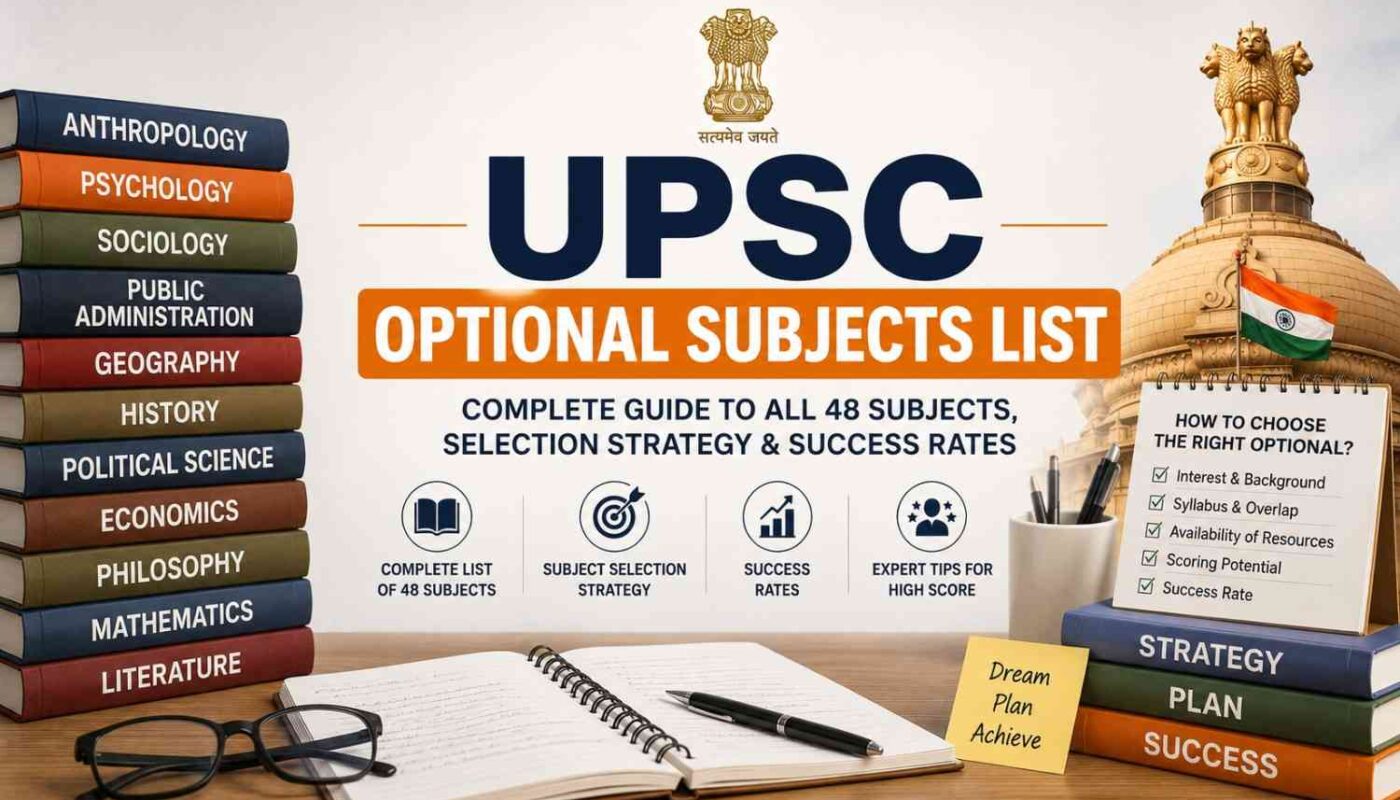
Complete List of 48 UPSC Optional Subjects (Official 2026 List)
UPSC allows candidates to pick one optional subject out of 48 listed in the official Civil Services Examination notification. This includes 25 conventional subjects and 23 literature options.
Core/Conventional Subjects (25):
- Agriculture
- Animal Husbandry and Veterinary Science
- Anthropology
- Botany
- Chemistry
- Civil Engineering
- Commerce and Accountancy
- Economics
- Electrical Engineering
- Geography
- Geology
- History
- Law
- Management
- Mathematics
- Mechanical Engineering
- Medical Science
- Philosophy
- Physics
- Political Science and International Relations (PSIR)
- Psychology
- Public Administration
- Sociology
- Statistics
- Zoology
Literature Options (any one language, 23 languages):
Assamese, Bengali, Bodo, Dogri, Gujarati, Hindi, Kannada, Kashmiri, Konkani, Maithili, Malayalam, Manipuri, Marathi, Nepali, Odia, Punjabi, Sanskrit, Santali, Sindhi, Tamil, Telugu, Urdu, and English.
Candidates opting for a language literature must have studied that language up to the graduation level or possess equivalent competence, as specified in the official notification – always cross-check eligibility conditions on upsc.gov.in before finalising your choice.
Which Optional Subjects Do Toppers Actually Choose?
Data speaks louder than opinion here. Looking at the UPSC CSE 2025 final result – declared in March 2026 – the diversity of optional subjects among top performers is striking, and it directly challenges the myth that only “safe,” humanities-heavy subjects can get you to the top.
- AIR 1, Anuj Agnihotri, an MBBS graduate from AIIMS Jodhpur, cracked the exam in his third attempt with Medical Science as his optional, scoring 292 out of 500 in the two optional papers. According to multiple reports, this was only the second time in roughly 15 years that a Medical Science optional-holder topped the exam – the earlier instance being 2011.
- AIR 2, Rajeshwari Suve M, an Electrical and Electronics Engineering graduate from Anna University, chose Sociology – a subject entirely outside her academic background, illustrating that optional choice doesn’t have to mirror your degree.
- Across the top 25 rank holders of CSE 2025, the optional subjects spanned Anthropology, Commerce and Accountancy, Chemistry, Economics, Electrical Engineering, History, Mathematics, Medical Science, Philosophy, Political Science and International Relations, Public Administration, and Sociology – a genuinely wide spread rather than a cluster around one or two “safe” choices.
The takeaway: there is no single universally “best” optional. Toppers succeed across engineering, medical, humanities, and social science optionals alike. What matters more is depth of preparation and fit with the individual candidate.
UPSC Optional Subjects Success Rate (Official DoPT Data)
The table below is based on the last officially released Department of Personnel & Training (DoPT) report breaking down optional-wise success rates. UPSC has not published a similarly granular optional-wise success breakdown in recent cycles, so this remains the most recent official reference point available; treat the percentages as indicative of long-term trends rather than a live snapshot of the current year.
| Optional Subject | Appeared | Recommended | Success Rate |
| Animal Husbandry & Veterinary Science | 16 | 3 | 18.8% |
| Commerce & Accountancy | 183 | 20 | 10.9% |
| Management | 54 | 6 | 11.1% |
| Economics | 243 | 26 | 10.7% |
| Civil Engineering | 146 | 15 | 10.3% |
| Law | 186 | 19 | 10.2% |
| Agriculture | 124 | 13 | 10.5% |
| Medical Science | 247 | 26 | 10.5% |
| Sociology | 1,263 | 126 | 10.0% |
| Anthropology | 1,189 | 108 | 9.1% |
| Zoology | 44 | 4 | 9.1% |
| Psychology | 164 | 15 | 9.1% |
| Mathematics | 539 | 45 | 8.3% |
| Chemistry | 156 | 13 | 8.3% |
| Public Administration | 705 | 58 | 8.2% |
| PSIR | 1,662 | 137 | 8.2% |
| Electrical Engineering | 200 | 16 | 8.0% |
| Physics | 165 | 12 | 7.3% |
| Botany | 28 | 2 | 7.1% |
| History | 751 | 51 | 6.8% |
| Philosophy | 439 | 27 | 6.2% |
| Mechanical Engineering | 213 | 12 | 5.6% |
| Geography | 1,916 | 105 | 5.5% |
| Geology | 30 | 0 | 0.0% |
| Statistics | 2 | 0 | 0.0% |
Important caveat: A high percentage success rate on a small applicant base (like Animal Husbandry, with only 16 candidates) is statistically fragile – a difference of one or two selections swings the percentage sharply. Popular subjects like Geography, PSIR, and Sociology draw large candidate pools, so their absolute number of recommended candidates is high even if the percentage looks moderate. Don’t pick a subject purely by chasing a percentage; read the sample size alongside it.
How to Choose the Right UPSC Optional Subject: A Practical Framework
Rather than following what’s “trending” in your test-prep WhatsApp group, weigh your decision against these five factors:
1. Genuine interest and sustainability. You will spend 8–12 months, often longer, with this subject. Pick something you can stay curious about through multiple revision cycles, not just something that sounds scoring on paper.
2. Academic or professional background. A prior degree in the subject (like Anuj Agnihotri’s MBBS feeding into Medical Science) gives you a head start on conceptual clarity, though it is not a prerequisite – many toppers, including AIR 2 of CSE 2025, chose optionals unrelated to their degree.
3. Overlap with General Studies. Subjects like Political Science and International Relations, Sociology, Public Administration, Geography, and History share significant syllabus overlap with GS Papers I, II, and III. This overlap means your optional preparation compounds your GS score too, effectively giving you double value for the same study hours.
4. Availability of study material and mentorship. Niche optionals (Geology, Statistics, certain language literatures) often have thinner test-series ecosystems and fewer evaluators experienced with those scripts, which can matter for structured feedback. Mainstream optionals have deeper resource pools but also fiercer competition.
5. Length and stability of the syllabus. Some optionals have had largely stable syllabi for years, letting you rely on well-tested standard texts; others see more frequent tweaks. Always cross-check the current syllabus PDF on the official UPSC notification before committing, since committing to outdated material is a common and costly mistake.
Common Mistakes Aspirants Make While Selecting an Optional
- Copying a topper’s choice blindly. A subject that worked brilliantly for one candidate’s background, writing style, and mentor guidance won’t automatically replicate for you.
- Switching optionals mid-preparation without a compelling reason, which resets months of syllabus familiarity.
- Ignoring answer-writing practice specific to the optional – optional papers reward structured, example-rich, and diagram-supported answers just as much as GS papers do.
- Underestimating current-affairs integration. Subjects like Economics, Geography, PSIR, and Public Administration increasingly draw questions that connect static syllabus with recent developments (policy changes, government reports, international events), so treating the optional as a purely “static” subject is a preparation gap.
Optional Subject Preparation Strategy for CSE 2027 Aspirants
- Map the syllabus first. Break the official syllabus into topics and sub-topics before opening a single book – this prevents over-reading low-weightage areas.
- Anchor on 2–3 standard texts per paper, supplemented by class notes or a reliable online course, rather than collecting material from a dozen sources.
- Start answer writing early, not in the final three months. Use previous year question papers to understand the verb of the question (analyse, critically examine, discuss) and structure accordingly.
- Take at least one full-length optional test series so you get used to writing two 250-mark papers under time pressure.
- Revise using self-made notes, not just textbooks, in the final 60 days – original texts are too dense to revisit multiple times before the exam.
- Track the previous 8–10 years of optional-subject question papers to spot recurring themes and shifting examiner emphasis.
- Build your timeline backward from May 2027. With Prelims provisionally expected on 23 May 2027, work backward: aim to finish a first full reading of your optional by December 2026, leave January–March 2027 for integrated GS-optional revision, and reserve April–May for full-length mock tests and rapid revision.
UPSC Optional Subjects: Frequently Asked Questions
UPSC offers 48 optional subjects in total – 25 conventional subjects (from Agriculture to Zoology, plus Law, Management, Medical Science, and the engineering disciplines) and 23 language literature options. Candidates select only one.
The optional subject contributes 500 marks in total, split across two papers (Paper VI and Paper VII) of 250 marks each, out of the 1750 marks that count toward the final Mains merit.
AIR 1 Anuj Agnihotri chose Medical Science, drawing on his MBBS background from AIIMS Jodhpur. AIR 2 Rajeshwari Suve M chose Sociology, despite holding an engineering degree – underlining that optional choice is not bound by your academic stream.
No single subject is universally best. Historically, Geography, Sociology, Public Administration, PSIR, and History have drawn large candidate pools and produced consistent numbers of selections, but success ultimately depends on preparation quality, answer-writing skill, and fit with the candidate’s strengths – not the subject label alone.
Yes, there is no bar on switching, but it comes at the cost of lost preparation time. Aspirants are generally advised to finalise their optional after a short trial period (reading the syllabus and a couple of introductory chapters) rather than switching repeatedly through the preparation cycle.
Always verify the current list, eligibility conditions for language literature papers, and detailed syllabus against the official UPSC Civil Services Examination notification published on upsc.gov.in, since minor eligibility or syllabus clarifications can be updated from year to year.
Based on the Commission’s published UPSC exam calendar pattern, the CSE 2027 notification is expected around mid-January 2027, with Prelims provisionally set for 23 May 2027. Ideally, finalise your optional subject well before the notification – most successful aspirants lock in their choice 10–12 months ahead of Prelims so they have adequate time for a full syllabus reading plus revision.
As of this writing, UPSC has not announced any change to the 48-subject optional list. The list has remained stable for several years. Always cross-check the official CSE 2027 notification once released, since UPSC reserves the right to revise the list or eligibility conditions.
This article is compiled and fact-checked using the latest publicly available UPSC notifications and verified reporting on UPSC CSE 2025 results (declared March 2026) and the UPSC CSE 2026/2027 exam calendar. Optional-subject success-rate figures are based on the most recent official DoPT report available at the time of writing; readers should cross-check against upsc.gov.in for the most current notification before finalising exam-related decisions.

One thought on “UPSC Optional Subjects List 2027: Complete Guide to All 48 Subjects, Selection Strategy & Success Rates”