 by
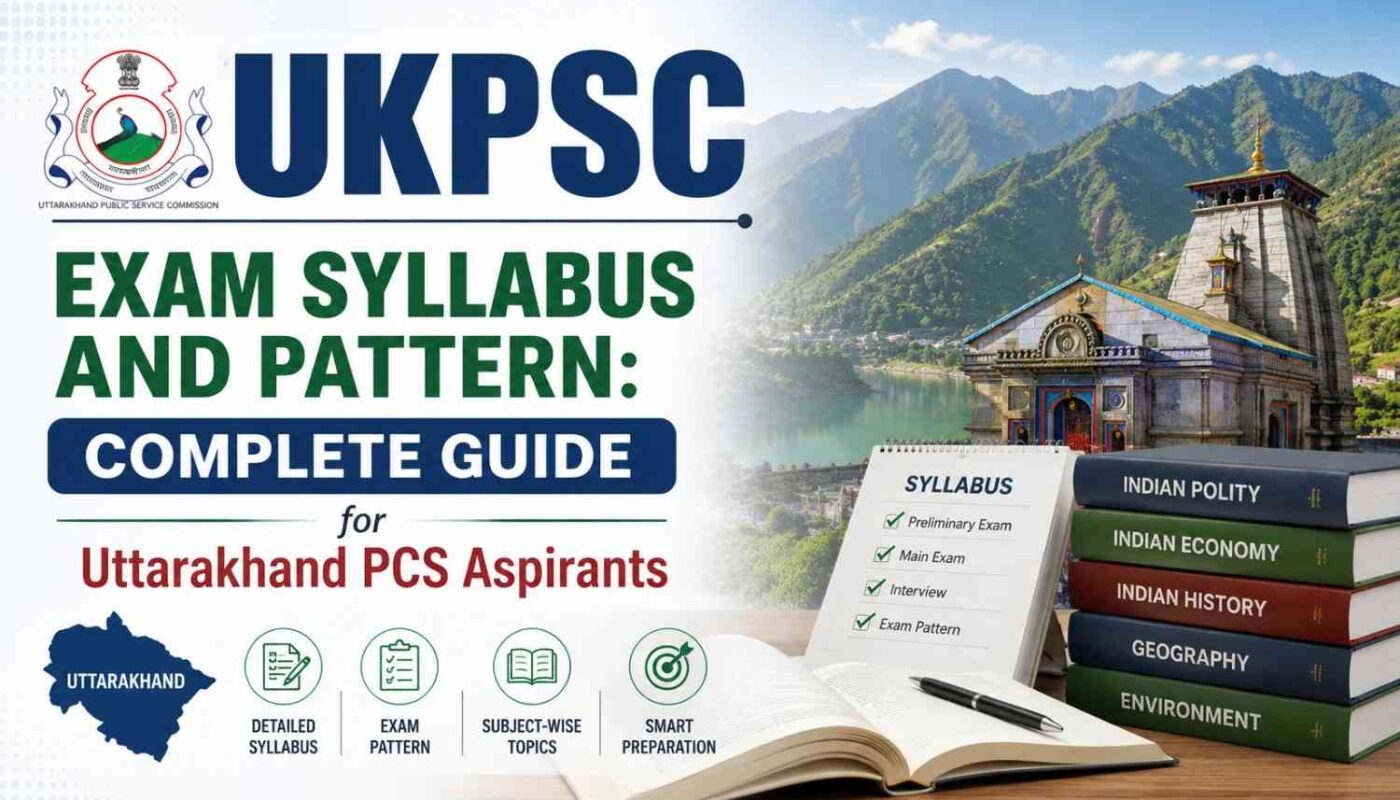
by The Uttarakhand Public Service Commission (UKPSC) conducts the Uttarakhand Combined State Civil/Upper Subordinate Services Examination every year to recruit officers for Group A and Group B administrative posts across the state – commonly known as UKPSC PCS or Uttarakhand PCS. For the 2025 recruitment cycle, UKPSC notified 123 vacancies under Advertisement No. A-1/E-1/PCS-2025/2025-26, and the Mains examination for this cycle was held from 27 to 30 April 2026 at centres in Haridwar and Haldwani. The next prelims cycle is tentatively expected around July 2026, though aspirants should always cross-check dates on the official UKPSC website, psc.uk.gov.in, since schedules are routinely revised.
If you’re preparing for this exam, the single most important document you’ll work from is the UKPSC syllabus. This guide breaks down the complete UKPSC exam pattern, marks distribution, and unit-wise syllabus for Prelims, Mains, and Interview – along with practical prep notes that go beyond just listing topics.
Quick Snapshot: UKPSC Exam at a Glance
| Stage | Nature | Papers | Total Marks |
| Prelims | Objective (MCQ), screening only | 2 papers | 300 marks (GS-1: 150, CSAT: 150 – qualifying) |
| Mains | Descriptive, merit-deciding | 8 papers | 1,450 marks |
| Interview | Personality test | 1 round | 150 marks |
| Grand Total (Mains + Interview) | – | – | 1,600 marks |
Unlike many state PCS exams, UKPSC’s Prelims marks are not added to the final merit – only Mains and Interview scores count toward your final rank. This makes Mains preparation disproportionately important, even though Prelims is what eliminates most candidates first.
UKPSC Selection Process: Three Stages
The selection process unfolds sequentially, and a candidate must clear each stage to advance to the next:
- Preliminary Examination – Two objective-type papers used purely to shortlist candidates (roughly 1:13 to 1:15 ratio of vacancies to qualifiers, depending on the year).
- Main Examination – Eight descriptive papers that actually determine your merit rank.
- Interview/Personality Test – A 150-mark round assessing administrative aptitude, not just knowledge.
UKPSC Prelims Exam Pattern
The Prelims stage has two papers, both objective in format:
- Paper 1 – General Studies: 150 marks, 150 questions. This paper’s score determines who advances to Mains.
- Paper 2 – General Studies-II (CSAT/General Aptitude Test): 150 marks, 100 questions. This is purely qualifying – every candidate, regardless of category, must score at least 33% to clear it, but the marks themselves don’t count toward the merit list.
Key rules to remember:
- Negative marking applies: Each wrong answer costs 1/4th (0.25) of the marks allotted to that question.
- Merit for Mains shortlisting is based only on Paper 1 (GS) scores – Paper 2 is a pass/fail filter.
- State-specific weightage: At least one-third of the questions in Paper 1 are drawn directly from Uttarakhand-specific content (history, geography, polity, economy, and current affairs of the state). This is a distinguishing feature of UKPSC compared to UPSC and many other state PCS exams, and it’s why generic “all-India” GS preparation alone won’t get you through.
UKPSC Prelims Syllabus (Paper 1: General Studies)
Unit 1: Indian History, Culture, National Movement, and History of Uttarakhand
Covers the full sweep of Indian history – from the Harappan and Vedic civilizations through the Mauryan, Gupta, and post-Gupta periods, the Delhi Sultanate and Mughal era, European colonization, the 1857 revolt, and the freedom movement up to Independence and Partition.
The Uttarakhand-specific portion is non-negotiable for this exam and includes: pre-historic and proto-historic Uttarakhand, the Kuninda and Yaudheya tribes, the Kartikeyapura and Katyuri dynasties, the Parmar dynasty of Garhwal, the Chand dynasty of Kumaon, the Gorkha invasion, British administration, the Tehri princely state, and regional freedom movements such as the role of Uttarakhand in 1857 and subsequent people’s movements (Chipko, Coolie Begar, anti-liquor agitation, and the statehood movement).
Unit 2: Indian and World Geography (including Uttarakhand)
World physical geography (latitudes, longitudes, landforms, oceans, climate systems), Indian geography (relief, drainage, monsoon, soils, agriculture, minerals, demography), and a dedicated Uttarakhand geography section covering its terrain, river systems, biodiversity, tourism circuits, natural hazards, and Scheduled Tribes.
Unit 3: Indian Polity (National, International, and Uttarakhand’s Political System)
The Constitution’s evolution, fundamental rights and duties, DPSPs, the federal structure, Panchayati Raj (73rd/74th Amendments), public policy and e-governance, and international bodies like the UN, SAARC, and BRICS. The Uttarakhand-specific segment covers the state’s governance structure, the Governor and CM’s office, the State Public Service Commission, Lokayukta, and special provisions for hill-state administration.
Unit 4: Economic and Social Development (National, International, and Uttarakhand)
Indian economic reforms, FDI, inflation, poverty-alleviation schemes, the Union Budget, agriculture and food security, and international trade bodies (WTO, IMF, World Bank). The Uttarakhand portion focuses on the state’s budget, natural-resource economy, tourism-driven growth, and the role of herbal/medicinal-plant industries in local livelihoods.
Unit 5: General Science and Technology
Everyday-science concepts, India’s S&T achievements, environment and ecology (biodiversity, climate change, pollution law), computer fundamentals and cyber law, chemistry and physics basics, and life sciences including biotechnology and genetically modified organisms.
Unit 6: Current Events of State, National, and International Importance
Awards, sports, books and authors, defence systems, health policy, cultural institutions, and significant national/global events – a fast-changing section that requires continuous current-affairs reading rather than one-time static revision.
UKPSC Prelims Syllabus (Paper 2: General Aptitude Test / CSAT)
This paper is qualifying (33% minimum) and tests:
- Reasoning and mental ability: Analogies, syllogisms, coding-decoding, series, Venn diagrams, statement-assumption and statement-conclusion logic, puzzle tests, and data sufficiency.
- Numerical ability: Number classification, divisibility rules, arithmetic reasoning, and basic statistical interpretation (tables, graphs, charts).
- English comprehension: A passage followed by questions on vocabulary, synonyms/antonyms, one-word substitution, and sentence transformation.
- Hindi comprehension (हिन्दी भाषा बोधगम्यता): An unseen passage with questions on theme, grammar, idioms (मुहावरे), figures of speech (अलंकार), and word classification (तत्सम, तद्भव, देशज).
UKPSC Mains Exam Pattern
Candidates who clear Prelims move to Mains – eight descriptive papers totaling 1,450 marks, which form the real backbone of your final rank. Add the 150 interview marks, and the grand total for merit is 1,600 marks.
| Paper | Subject | Marks |
| 1 | General Hindi | 150 |
| 2 | Essay | 150 |
| 3 | General Studies-I | 200 |
| 4 | General Studies-II | 200 |
| 5 | General Studies-III | 200 |
| 6 | General Studies-IV | 200 |
| 7 | General Studies-V (Uttarakhand-specific) | 150 |
| 8 | General Studies-VI (Uttarakhand-specific) | 150 |
(Note: Marks distribution across GS-V and GS-VI can be revised by UKPSC between cycles – always confirm against the latest official notification before finalizing your study plan.)
UKPSC Mains Syllabus: Paper-by-Paper Breakdown
Paper 1: General Hindi
Tests command over written Hindi – grammar, comprehension, translation, and formal/informal writing as prescribed in the official notification.
Paper 2: Essay
Candidates write three essays of 700–800 words each, one from each of three sections, carrying 50 marks per essay (150 total):
- Section A: Literature & culture, social issues, politics, and the agriculture/industry/trade economy.
- Section B: Science & technology, environment, national/international events, natural disasters, and development programmes.
- Section C: Uttarakhand-specific themes – social structure, history and culture, economic/geographic profile, tourism and migration, disaster management, and women’s empowerment in the state.
Evaluation criteria include language accuracy, originality of thought, multi-dimensional analysis, logical structure, and clarity of expression – so structured, well-planned essays consistently outscore generic, padded ones.
Paper 3: General Studies-I – Indian Heritage, Culture, History, and World Geography
Indian art, architecture, and literature; modern Indian history from the mid-18th century onward; the freedom struggle; post-independence consolidation; world history (industrial revolution, world wars, decolonization); Indian society’s diversity, gender issues, and urbanization; and world/Indian physical geography including natural-resource distribution and geophysical phenomena.
Paper 4: General Studies-II – Governance, Constitution, Polity, Social Justice, and International Relations
Constitutional evolution and structure, Centre-State relations, separation of powers, Parliament and state legislatures, the judiciary, constitutional bodies, welfare schemes for vulnerable groups, e-governance, civil services’ role in democracy, and India’s foreign relations including its neighbourhood policy and major global institutions.
Paper 5: General Studies-III – Technology, Economic Development, Biodiversity, Environment, Security, and Disaster Management
Indian economic planning, budgeting, agriculture and PDS, food security, industrial policy, infrastructure, science and tech applications, IPR, environmental conservation, disaster management, and internal security challenges including cybersecurity and border management.
Paper 6: General Studies-IV – Ethics, Integrity, and Aptitude
A case-study-driven paper testing ethical reasoning: human values, attitude and emotional intelligence, probity in governance, RTI, corporate governance, and applied ethics in public administration – closely mirroring the UPSC Ethics paper in structure.
Paper 7: General Studies-V – Uttarakhand History, Society, and Polity
A deep dive into the state’s history (from pre-historic settlements through the Katyuri, Parmar, and Chand dynasties to British rule and the Tehri princely state), regional social movements (Chipko, anti-liquor, statehood agitation), Uttarakhand’s society and folk culture, and its administrative and political machinery including local self-government and public policy initiatives.
Paper 8: General Studies-VI – Uttarakhand Geography, Economy, and Development
Physical geography, climate, glaciers, and natural resources of Uttarakhand; the state economy and its dependence on tourism, horticulture, and hydropower; industrial policy and MSMEs; public finance; disaster management specific to a Himalayan terrain (cloudbursts, landslides, earthquakes, avalanches); and human-development indicators including education and health infrastructure.
UKPSC Interview (Personality Test)
The Interview is the final stage, worth 150 marks, conducted only for candidates who clear Mains. It isn’t a knowledge re-test – the board evaluates:
- Communication clarity and confidence
- Decision-making and problem-solving approach
- Awareness of current affairs, governance, and ethical dilemmas
- Understanding of Uttarakhand’s social, economic, and administrative landscape
- Overall suitability for the responsibilities of civil service
What Makes UKPSC Different From Other State PCS Exams
Having tracked multiple PCS syllabi, a few structural quirks of UKPSC stand out and are worth flagging for aspirants switching over from UPSC or another state’s PCS prep:
- Two dedicated Uttarakhand papers in Mains (GS-V and GS-VI) – most state PCS exams fold state-specific content into one paper or scatter it across GS papers. UKPSC gives it two full papers worth 300 marks combined, making it the single highest-weightage block in the entire Mains.
- Prelims marks don’t count toward merit – only the Mains and Interview (1,600 marks total) decide your final rank, so don’t over-invest revision time in Prelims at the cost of Mains answer-writing practice.
- One-third of Prelims GS questions are Uttarakhand-specific – a candidate with strong “all-India” GS knowledge but zero regional preparation will likely fail to clear the cut-off.
- Negative marking is moderate (−0.25), similar to UPSC, so calculated guessing still has a place in your exam strategy – but verify the latest notification each cycle, as marking schemes can be revised.
How to Prepare: A Practical Approach
- Start with the Uttarakhand-specific papers early, not last. Most aspirants treat GS-V/GS-VI as an afterthought and lose 300 easy-to-score marks because they delay state-specific revision.
- Build a single, running current-affairs file that tags entries as “National” or “Uttarakhand” – since both Prelims Unit 6 and the Mains GS papers draw from overlapping current-affairs pools.
- Practice answer writing for all eight Mains papers, not just GS. Hindi and Essay are often under-prepared despite carrying 300 marks combined.
- Revisit the official notification every cycle. Marks distribution, paper-wise weightage, and minimum qualifying percentages have shifted between cycles in the past, so treat any syllabus breakdown – including this one – as a planning guide to be verified against psc.uk.gov.in before your final exam.
Frequently Asked Questions
No. Prelims is purely a screening stage. Only Mains (1,450 marks) and Interview (150 marks) – a total of 1,600 marks – are counted for the final merit list.
Eight: General Hindi, Essay, and General Studies I through VI (with GS-V and GS-VI dedicated to Uttarakhand-specific content).
One-fourth (0.25) of the marks allotted to a question is deducted for each wrong answer in the objective papers.
No. Paper 2 (General Aptitude Test/CSAT) is qualifying only; candidates need a minimum of 33% to clear it, but the score itself isn’t added to the merit list.
The 2025 cycle (Advertisement No. A-1/E-1/PCS-2025/2025-26) notified 123 vacancies, with the Mains exam held from 27–30 April 2026. Vacancy numbers vary every year based on government requirements, so check the latest notification for current figures.
Disclaimer: Exam dates, vacancy numbers, and marks distribution are subject to revision by the Uttarakhand Public Service Commission. Always verify current details against the official notification on psc.uk.gov.in before finalizing your preparation strategy.