 by
by If you’re preparing for the UP Lekhpal exam, here’s an important update most guides haven’t caught up with yet: the written exam is already over. The UPSSSC conducted the Lekhpal (Rajasva Lekhpal) Mains exam on 21 May 2026, and the provisional answer key was released just a day later, on 22 May 2026. So if you’re reading this in June 2026 or later, your preparation timeline has shifted – you’re either waiting on the result or gearing up for the next recruitment cycle.
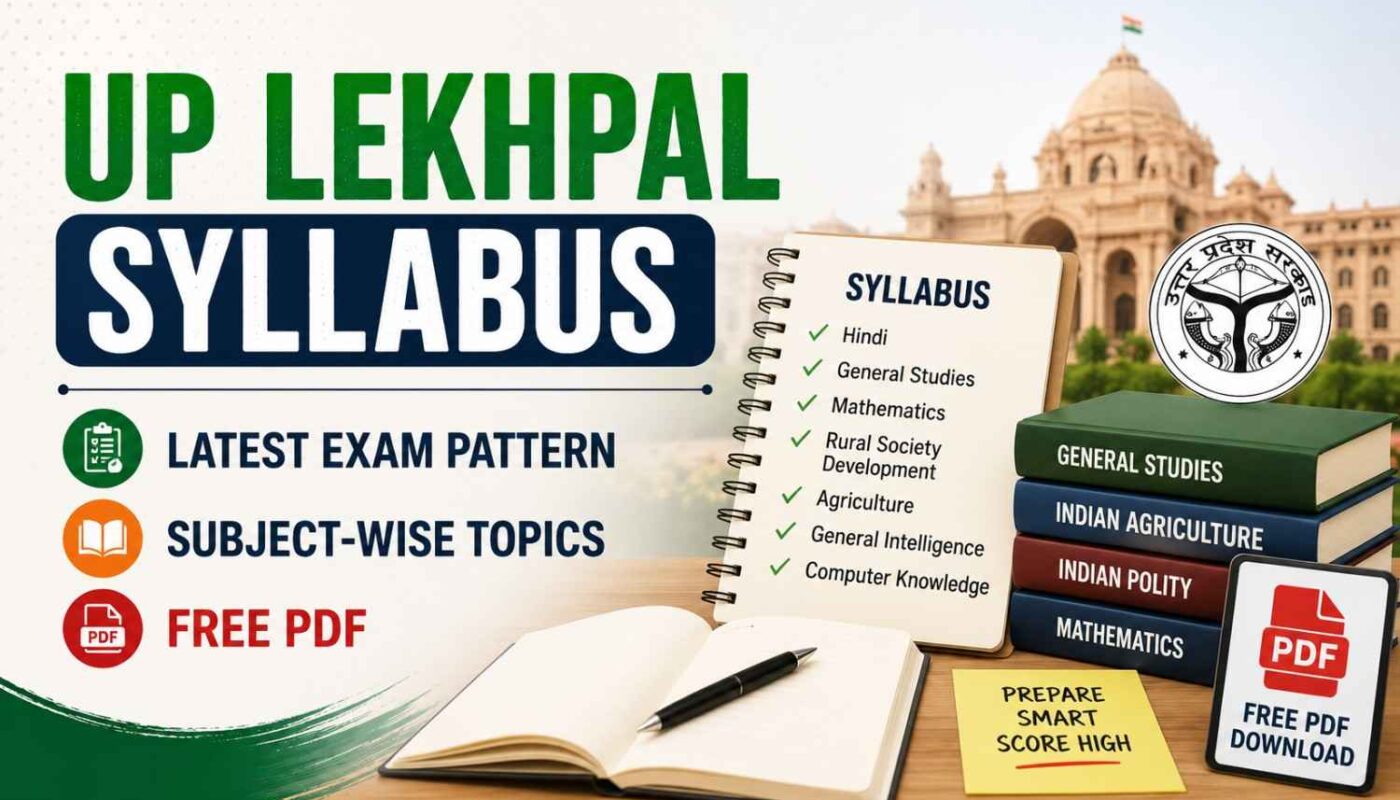
This guide walks through the complete UP Lekhpal syllabus and exam pattern as notified by the Uttar Pradesh Subordinate Services Selection Commission (UPSSSC), along with where things currently stand post-exam, so you have one accurate, up-to-date reference instead of piecing it together from five different sources.
Quick Recap: What Happened With UP Lekhpal Recruitment 2025–26
The UPSSSC released the Lekhpal recruitment notification (Advertisement No. 02-Exam/2025) on 16 December 2025, inviting applications for 7,994 Rajasva Lekhpal vacancies under the Board of Revenue, Uttar Pradesh. Here’s how the timeline actually played out:
| Stage | Date |
| Notification released | 16 December 2025 |
| Online application window | 29 December 2025 – 28 January 2026 |
| PET-qualified candidates eligible | Based on UPSSSC PET 2025 normalized scores |
| Admit card released | Early May 2026 |
| Mains written exam conducted | 21 May 2026 (10:00 AM – 12:00 Noon, single shift) |
| Provisional answer key released | 22 May 2026 |
| Objection window | 22 May – 28 May 2026 (closed) |
| Final answer key & result | Expected June 2026 |
Around 3.66 lakh candidates were eligible to sit for the exam, which was held across 861 centres in 44 districts of Uttar Pradesh. Candidates who appeared can no longer raise objections (the window closed on 28 May), so the next milestone to track is the final answer key and result, both expected to be announced on upsssc.gov.in sometime in June 2026.
If you missed this cycle, don’t worry – UPSSSC conducts Lekhpal recruitment periodically, and the syllabus and pattern below will remain the reference point for the next notification too.
UP Lekhpal Eligibility Snapshot
- Qualification: Class 12th (Intermediate) pass from a recognised board
- PET requirement: Must have qualified UPSSSC PET (Preliminary Eligibility Test) with a valid normalized score
- Age limit: 18 to 40 years (as of 1 July 2025 for this cycle), with standard UP government age relaxation for reserved categories
- Nationality: Indian citizen
- Bonus points: Preference is given to candidates with Territorial Army service of at least two years, or an NCC ‘B’ certificate
UP Lekhpal Exam Pattern 2026 – What Actually Changed
Here’s where a lot of older study material falls behind: the Mathematics section has been scrapped from this exam cycle. In its place, UPSSSC introduced a Data Interpretation component, and added two entirely new sections – Environmental Ecology & Disaster Management and Computer & Information Technology – that weren’t part of earlier Lekhpal exams.
Key exam facts:
- Total questions: 100, all objective/MCQ
- Total marks: 100 (1 mark per correct answer)
- Negative marking: 0.25 marks deducted per wrong answer
- Duration: 2 hours
- Mode: Offline (pen-and-paper, OMR-based)
Section-Wise Marks Distribution
| Part | Subject | Questions | Marks |
| Part 1 | General Hindi | 10 | 10 |
| Part 1 | History of India & Indian National Movement | 5 | 5 |
| Part 1 | Indian Polity & Constitution | 5 | 5 |
| Part 1 | Geography of India & the World | 5 | 5 |
| Part 1 | Indian Economy & Social Development | 5 | 5 |
| Part 1 | Rural Society & Development | 5 | 5 |
| Part 1 | Current Affairs (National & International) | 5 | 5 |
| Part 1 | Science & Technology | 5 | 5 |
| Part 1 | Environmental Ecology & Disaster Management | 10 | 10 |
| Part 1 | Data Interpretation | 10 | 10 |
| Part 2 | Computer & Information Technology | 15 | 15 |
| Part 3 | General Knowledge of Uttar Pradesh | 20 | 20 |
| Total | 100 | 100 |
Notice how heavily the paper leans toward two areas: UP-specific General Knowledge (20 marks) and Computer/IT awareness (15 marks). Combined with Environmental Ecology & Disaster Management and Data Interpretation, these four relatively newer or state-specific sections now account for 55 of the 100 marks – over half the paper. Candidates relying on outdated Lekhpal prep material built around the old Maths-heavy pattern would have been caught off guard.
UP Lekhpal Syllabus 2026 – Subject-Wise Breakdown
1. General Hindi (10 Questions | 10 Marks)
This section tests practical and grammatical command of Hindi rather than literature. Expect questions on:
- Drafting official, semi-official, personal, and professional letters, notices, circulars, and orders
- Varna and Dhwani Vichar (phonetics): pronunciation, vowels, consonants, matras
- Shabd Rachna: sandhi, sandhi-vichchhed, samas, upsarg, pratyay
- Word types – tatsam, ardha-tatsam, tadbhav, deshaj, videshi words; parts of speech (noun, pronoun, adjective, verb, indeclinables)
- Shabd Gyan: synonyms, antonyms, homophones with different meanings, one-word substitutions
- Shabd Shuddhi (correcting word usage), grammatical categories (gender, number, person, tense, voice)
- Sentence structure – simple, compound, complex; sentence correction
- Punctuation marks
- Idioms and proverbs (Muhavare, Lokoktiyan)
2. History of India & Indian National Movement (5 Questions | 5 Marks)
- Social, cultural, economic, and political aspects of Indian history
- Rise of nationalism and the freedom movement’s major phases
- Key leaders, organisations, and milestones of the independence struggle
- Events leading up to Indian independence
3. Indian Polity & Constitution (5 Questions | 5 Marks)
- Evolution of the Constitution; its key features and structure
- Fundamental Rights, Fundamental Duties, and Directive Principles
- Union government structure – President, Parliament, Prime Minister
- State government structure – Governor, Legislature, Chief Minister
- Panchayati Raj and local self-government
- Public policy and community development issues
4. Geography of India & the World (5 Questions | 5 Marks)
India:
- Physical, social, and economic geography
- Agriculture, horticulture, forestry, and animal husbandry
- Population distribution, urbanisation, smart cities/villages initiatives
World:
- Physical features and major climatic zones
- Global population trends and key economic regions
5. Indian Economy & Social Development (5 Questions | 5 Marks)
- Economic planning – objectives, achievements, and the role of NITI Aayog
- Sustainable Development Goals (SDGs)
- Government budget components and India’s financial system
- Agricultural and industrial growth, trade and commerce
- Land reforms post-independence; effects of liberalisation and globalisation
- Infrastructure – power, ports, roads, railways, airports
6. Rural Society & Development (5 Questions | 5 Marks)
Don’t underestimate this section – it’s conceptually broad despite its low question count:
- Concept of rural society and rural development in the Indian context
- Major rural development programmes and schemes (central and state)
- Rural development administration and research systems
- Rural health schemes and rural land reforms
- Rural social development initiatives
7. Current Events of National & International Importance (5 Questions | 5 Marks)
- Recent national and international news and developments
- Major government policies, international agreements, and global events
- This section rewards candidates who follow a daily current affairs routine in the months leading up to the exam, rather than last-minute cramming
8. Science & Technology (5 Questions | 5 Marks)
- India’s Science & Technology policy and its applications to national development and security
- Notable achievements of Indian scientists and indigenisation of technology
- Space and defence technology developments
- Energy technologies, nanotechnology, basics of biotechnology and microbiology
- Intellectual property rights and digital rights issues
9. Environmental Ecology & Disaster Management (10 Questions | 10 Marks)
This is a newly introduced, high-weightage section for the current exam cycle, so don’t skip it assuming low prior-year relevance.
Environmental Ecology:
- Ecosystems and biodiversity, wildlife conservation
- Pollution, environmental degradation, and impact assessment
- Climate change fundamentals
Disaster Management:
- Disaster Management Act, 2005
- National Disaster Management Authority (NDMA) and State Disaster Management Authority (SDMA)
- National Disaster Response Force (NDRF) and State Disaster Response Force (SDRF)
- Disaster mitigation principles and global disaster management efforts
10. Data Interpretation (10 Questions | 10 Marks)
This effectively replaces the old Mathematics section:
- Interpreting statistical data, graphs, and data sets
- Bar charts, line graphs, pie charts, tables, and diagrams
- Drawing logical conclusions from numerical data
Tip: Since this isn’t a pure arithmetic section, practice speed-reading charts and tables rather than drilling formula-heavy problems – the skill being tested is interpretation, not calculation.
11. Computer & Information Technology (15 Questions | 15 Marks)
Another section added fresh to this cycle, and one of the highest-weightage individual subjects on the paper:
- History, introduction, and applications of computers, IT, Internet, and the World Wide Web
- Hardware, software, input/output devices, IP addressing
- Email creation and usage; operating printers, tablets, and mobile devices
- MS Word and MS Excel essentials
- Operating systems, social networking, e-Governance
- Digital financial tools (UPI, digital payments) and cybersecurity basics
- Emerging tech: Artificial Intelligence, Machine Learning, Deep Learning, Big Data, Internet of Things (IoT), and India’s progress in these fields
Given how fast this space evolves, candidates should also stay current on recent government digital initiatives (like updates to Digital India programmes) rather than relying solely on static textbook definitions.
12. General Knowledge of Uttar Pradesh (20 Questions | 20 Marks)
The single highest-weightage section on the entire paper – this alone is worth a fifth of your total score:
- History, culture, art, and architecture of UP
- Festivals, folk dances, literature, and regional languages
- Heritage, social customs, and tourism
- Geography, climate, soil, forests, wildlife, and mineral resources
- UP’s economy, agriculture, industry, business, and employment landscape
- State polity and administration
- Recent achievements and current events specific to Uttar Pradesh
Preparation tip: Because this section is so UP-centric, generic national GK books won’t cut it. Prioritise UP-specific current affairs from the last 6–12 months, state government schemes, and recent infrastructure/development news from Uttar Pradesh.
Where to Find the Official Syllabus PDF
Always cross-verify your preparation against the official UPSSSC notification PDF, available on upsssc.gov.in under the Lekhpal recruitment (Advt. No. 02-Exam/2025) section. Third-party syllabus PDFs are useful for quick reference, but the official notification remains the final word on exam pattern and marking scheme, especially since this cycle introduced multiple structural changes.
What’s Next After the Exam?
If you appeared for the 21 May 2026 exam, here’s the realistic sequence ahead:
- Final answer key – expected to be published in June 2026 after UPSSSC reviews objections raised during the 22–28 May window
- Result declaration – typically follows the final answer key by a few weeks; track upsssc.gov.in for the official PDF
- Document verification (DV) – shortlisted candidates based on the merit list will be called for DV
- Final selection – based on combined performance and successful document verification
There’s no fixed cap on the number of attempts for the Lekhpal exam, so even if this cycle doesn’t work out, you remain eligible to reattempt in future UPSSSC PET-linked recruitment drives.
Frequently Asked Questions
Yes. The UPSSSC Lekhpal Mains written exam for 7,994 vacancies was held on 21 May 2026 in a single shift (10 AM–12 Noon) across 861 centres in 44 districts of Uttar Pradesh.
No. Mathematics has been removed from the 2025–26 exam pattern and replaced with a 10-question Data Interpretation section.
The current syllabus spans 12 subject areas across three parts, including two newly added sections – Environmental Ecology & Disaster Management, and Computer & Information Technology.
Yes, 0.25 marks are deducted for every incorrect answer.
The result is expected in June 2026, after the final answer key is published, though UPSSSC has not announced an exact date yet.
The exam is 100 marks, 100 questions, to be completed in 2 hours.
General Knowledge of Uttar Pradesh carries the highest weightage at 20 marks, followed by Computer & IT (15 marks).
No, the objection window closed on 28 May 2026 for this exam cycle.
This article is intended as an independent, updated reference on the UP Lekhpal syllabus and exam pattern based on UPSSSC’s official notification and post-exam updates. For application status, hall tickets, and official results, always refer to upsssc.gov.in.