 by
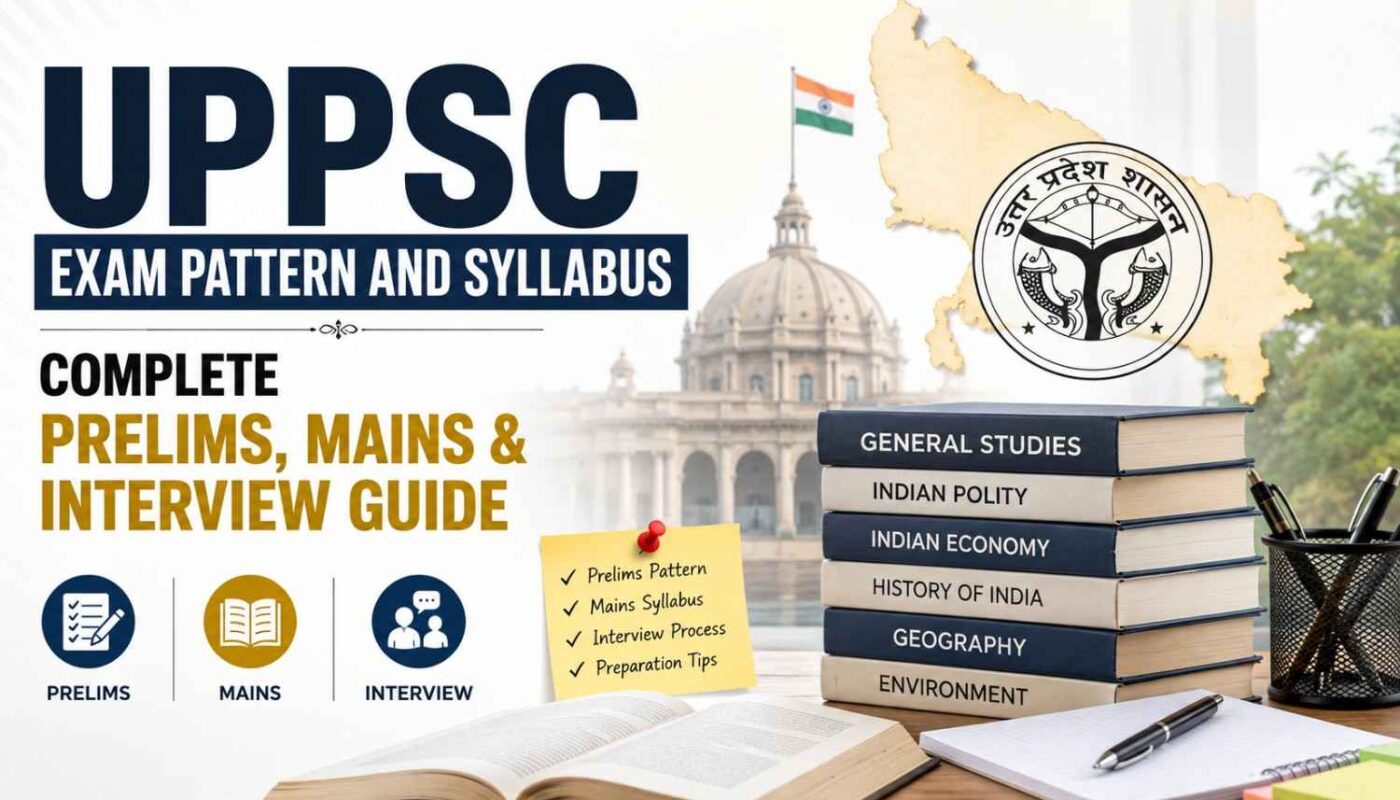
by The Uttar Pradesh Public Service Commission (UPPSC) conducts the Combined State/Upper Subordinate Services Examination – popularly known as UP PCS – every year to recruit officers for prestigious Group A and Group B gazetted posts such as Deputy Collector (SDM), Deputy Superintendent of Police (DSP), Block Development Officer (BDO), and Sub-Registrar. With the UPPSC Exam Calendar 2026 already released by the commission, aspirants now have a clearer picture of when the next Prelims is likely to take place – making this the right time to understand the syllabus and exam pattern in detail.
This guide breaks down every stage of the UPPSC PCS exam – Prelims, Mains, and Interview – along with the latest structural changes, marking scheme, and subject-wise syllabus, so you can build an exam-focused study plan rather than relying on guesswork.
What’s New in the UPPSC Exam Pattern (Quick Update)
Before diving into the details, here are the most important recent changes every aspirant should know:
- Optional subjects have been completely scrapped from the UPPSC Mains. In their place, two compulsory papers – General Studies V and VI – have been introduced, focusing entirely on Uttar Pradesh’s history, geography, governance, and economy.
- According to the UPPSC Exam Calendar 2026, released on January 30, 2026, the PCS Prelims 2026 is tentatively scheduled for December 6, 2026, though the official recruitment notification with vacancy and application details was still awaited as of mid-2026. Always cross-check the latest schedule on the official UPPSC website (uppsc.up.nic.in), since dates are provisional and subject to revision.
- The 2025-cycle Prelims was conducted on October 12, 2025, with the corresponding Mains held from March 29 to April 1, 2026 – a useful reference point for understanding the commission’s typical prelims-to-mains gap.
- Roughly 200 vacancies were notified for the 2025 cycle; the number for 2026 is expected to be announced with the official notification and historically tends to increase before results are declared.
UPPSC Selection Process: 3 Stages
The UPPSC PCS exam follows a three-stage selection process, similar in structure to the UPSC Civil Services Exam but with a distinct state-specific component:
- Preliminary Exam – Two objective-type papers (screening stage only)
- Mains Exam – Eight descriptive papers (merit-deciding stage)
- Personality Test / Interview – Final stage assessing suitability for administrative roles
Marks scored in the Prelims are not added to the final merit list – they are used solely to shortlist candidates for the Mains. Only Mains and Interview marks count toward the final ranking.
UPPSC Syllabus 2026: Stage-Wise Overview
| Stage | Paper/Subject | Marks | Questions/Format |
| Prelims | Paper I – General Studies | 200 | 150 MCQs |
| Prelims | Paper II – CSAT (Qualifying) | 200 | 100 MCQs |
| Mains | General Hindi | 150 | Descriptive |
| Mains | Essay | 150 | Descriptive |
| Mains | General Studies I | 200 | Descriptive |
| Mains | General Studies II | 200 | Descriptive |
| Mains | General Studies III | 200 | Descriptive |
| Mains | General Studies IV | 200 | Descriptive |
| Mains | General Studies V (UP-specific) | 200 | Descriptive |
| Mains | General Studies VI (UP-specific) | 200 | Descriptive |
| Interview | Personality Test | 100 | Viva-voce |
Total Mains marks: 1,500 | Final Merit (Mains + Interview): 1,450 (since Hindi and Essay papers are qualifying in nature for merit calculation in some cycles – always verify the latest notification for exact weightage rules).
UPPSC Prelims Exam Pattern 2026
The Prelims is purely a screening test; its marks don’t count toward final merit. It consists of two papers conducted on the same day.
| Particulars | Details |
| Name of Exam | UPPSC PCS Preliminary Examination |
| Number of Papers | Paper 1 – General Studies I; Paper 2 – General Studies II (CSAT) |
| Duration | 2 hours per paper (Paper 1: 9:30 AM–11:30 AM; Paper 2: 2:30 PM–4:30 PM) |
| Maximum Marks | 200 marks each; only Paper 1 counts for merit ranking |
| Qualifying Criteria for Paper 2 | Minimum 33% marks (qualifying only, not counted for ranking) |
| Number of Questions | Paper I: 150; Paper II: 100 |
| Negative Marking | 0.33 marks deducted per incorrect answer |
| Question Type | Objective (MCQ) |
Why Paper II (CSAT) Still Matters
Even though CSAT is qualifying in nature, a significant number of candidates fail to clear the 33% threshold each year, especially those weak in quantitative aptitude or English comprehension. Treating CSAT as “low priority” is one of the most common mistakes UPPSC aspirants make – daily practice of 40–50 questions in comprehension, reasoning, and elementary mathematics is recommended from the early stages of preparation.
UPPSC Prelims Syllabus 2026: Paper I (General Studies)
1. Current Events of National and International Importance
Candidates are expected to track major developments across politics, economy, science, sports, and international relations.
2. History of India and the Indian National Movement
Focus on the social, economic, and political dimensions of Indian history, along with a clear understanding of the nature, growth, and key milestones of the freedom movement.
3. Indian and World Geography
Physical, social, and economic geography of India, with only a general understanding required for World Geography.
4. Indian Polity and Governance
Constitutional framework, political system, Panchayati Raj, public policy, and rights-related issues.
5. Economic and Social Development
Sustainable development, poverty, inclusion, demographic trends, and social-sector initiatives, along with population–environment–urbanisation linkages.
6. Environmental Ecology, Biodiversity, and Climate Change
General awareness-level questions; no subject specialisation required.
7. General Science
Everyday scientific knowledge expected of an educated person, not specialised technical understanding.
Note: UPPSC frequently weaves Uttar Pradesh-specific context into each of these topics, so candidates should pair NCERT-level national content with UP-focused current affairs and state policy updates.
UPPSC Prelims Syllabus 2026: Paper II (CSAT)
- Comprehension
- Interpersonal and communication skills
- Logical reasoning and analytical ability
- Decision-making and problem-solving
- General mental ability
- Elementary Mathematics (up to Class X) – Arithmetic, Algebra, Geometry, Statistics
- General English (up to Class X)
- General Hindi (up to Class X / हाईस्कूल स्तर)
Elementary Mathematics Breakdown
| Area | Key Topics |
| Arithmetic | Number systems, average, ratio-proportion, percentage, profit-loss, simple/compound interest, time-work, speed-time-distance |
| Algebra | Polynomials, LCM/HCF, remainder theorem, linear & quadratic equations, set theory |
| Geometry | Triangles, quadrilaterals, circles, perimeter/area, volume & surface area of solids |
| Statistics | Data collection/classification, frequency distribution, bar/pie charts, histograms, mean/median/mode |
General English (Class X Level)
Comprehension, active-passive voice, parts of speech, sentence transformation, direct-indirect speech, punctuation, vocabulary, idioms, and fill-in-the-blanks.
सामान्य हिंदी (हाईस्कूल स्तर)
हिंदी वर्णमाला, विराम चिन्ह, शब्द एवं वाक्य रचना, संधि-समास, अनेकार्थी व विलोम शब्द, पर्यायवाची शब्द, मुहावरे-लोकोक्तियाँ, तत्सम-तद्भव शब्द, वर्तनी, अर्थबोध, तथा उ.प्र. की प्रमुख बोलियाँ।
UPPSC Mains Exam Pattern 2026
Only candidates who clear the Prelims are called for the Mains, which is the actual merit-deciding stage of the exam.
| Particulars | Details |
| Name of Exam | UPPSC PCS Mains (Written) Examination |
| Number of Papers | 8 (General Hindi, Essay, GS I–VI) |
| Duration | Spread across roughly a week |
| Sessions | Morning: 9:30 AM–12:30 PM; Afternoon: 2:00 PM–5:00 PM |
| Maximum Marks | Hindi & Essay: 150 each; GS I–VI: 200 each (Total: 1,500) |
| Exam Mode | Offline, pen-and-paper |
| Question Type | Descriptive |
| Negative Marking | None |
Key Structural Shift: No More Optional Subject
Unlike the UPSC Civil Services Mains, UPPSC has removed the optional subject entirely. Candidates who previously chose subjects like History, Geography, or Public Administration as an optional paper now instead attempt GS Paper V and GS Paper VI, both centred on Uttar Pradesh-specific content. This is a major preparation shift: aspirants need dedicated, UP-focused study material rather than relying solely on national-level GS resources.
UPPSC Mains Syllabus 2026 (Paper-Wise)
Paper 1: सामान्य हिंदी
गद्य खंड अवबोधन, संक्षेपण, सरकारी/अर्धसरकारी पत्र लेखन, शब्द ज्ञान (उपसर्ग-प्रत्यय, विलोम शब्द, वाक्यांश हेतु एक शब्द), वर्तनी शुद्धि, तथा लोकोक्ति-मुहावरे।
Paper 2: Essay
Three sections, one topic chosen from each, each essay written in approximately 700 words:
- Section A: Literature & Culture / Social / Political spheres
- Section B: Science, Environment & Technology / Economic / Agriculture-Industry-Trade
- Section C: National & International Events / Natural Calamities / National Development Programmes
Paper 3: General Studies I
Indian culture and history (ancient to modern), the Freedom Struggle, post-independence consolidation, World History (18th–20th century), Indian society and culture, women’s issues, liberalization-privatization-globalization, physical geography, natural resources, and population-settlement patterns.
Paper 4: General Studies II
Indian Constitution, Centre-State relations, Parliament and State Legislatures, judiciary and executive structure, governance and e-governance, welfare schemes, India’s foreign relations, and current national/international affairs.
Paper 5: General Studies III
Economic planning, NITI Aayog, SDGs, budget and financial systems, agriculture and food security, industrial policy, infrastructure, science & technology applications, environmental security, disaster management, and internal/external security challenges.
Paper 6: General Studies IV
Ethics and human interface, human values, attitude and aptitude, emotional intelligence, civil service values, probity in governance, and ethics-based case studies.
Paper 7: General Studies V (Uttar Pradesh-Specific)
UP’s history, culture, and ancient cities; freedom struggle contributions from UP; political and administrative system of the state; local self-government; good governance initiatives; land reforms; internal security; education and health systems; tourism; and current affairs of UP.
Paper 8: General Studies VI (Uttar Pradesh-Specific)
UP’s economy, budget, infrastructure, trade and industry; state government welfare schemes (including One District One Product policy); agriculture and forestry; demography; geography and natural resources of UP; environmental issues; and public-private partnership models for state development.
UPPSC Interview / Personality Test
The final stage carries 100 marks and is conducted by a board constituted by the UPPSC. It is designed as a purposeful conversation to assess a candidate’s:
- Mental alertness and analytical ability
- Clarity of thought and expression
- Administrative aptitude and balance of judgment
- Awareness of state and national issues
Unlike a knowledge-testing exam, the interview evaluates overall personality suitability for a public administration role – preparation should focus on current affairs, the candidate’s Detailed Application Form (DAF), and UP-specific governance issues.
How to Prepare: A Practical Roadmap
- Start CSAT practice from day one – don’t leave it for the last month; daily practice keeps you safely above the 33% cut-off.
- Separate your UP-specific preparation for GS V and VI from general national-level GS – use state board books, UP government reports, and UP-focused current affairs sources.
- Practice answer writing weekly, especially for the Essay paper (700-word structured essays) and the descriptive GS papers.
- Solve at least 5 years of previous year papers to understand UPPSC’s specific question-framing style, which often differs from UPSC.
- Track the official UPPSC Exam Calendar regularly on uppsc.up.nic.in, since prelims and mains dates have shifted in recent cycles and provisional dates can change.
Frequently Asked Questions
No. UPPSC has removed the optional subject system. GS Papers V and VI (focused entirely on Uttar Pradesh) have replaced it.
No. The Prelims is purely a qualifying/screening stage. Only Mains and Interview marks determine the final merit.
CSAT is qualifying only. Candidates need a minimum of 33% to clear it; the marks are not added to the merit ranking.
0.33 marks are deducted for every incorrect answer in both Prelims papers.
Yes, candidates from any state can apply; however, reservation and age-relaxation benefits typically apply only to Uttar Pradesh domicile holders – check the official notification for exact eligibility criteria each year.
Disclaimer: Exam dates, vacancy numbers, and marking patterns are based on the most recent official UPPSC notifications and exam calendar available at the time of writing. Since the commission periodically revises these details, candidates are strongly advised to cross-verify all information on the official UPPSC website (uppsc.up.nic.in) before finalizing their preparation strategy.