 by
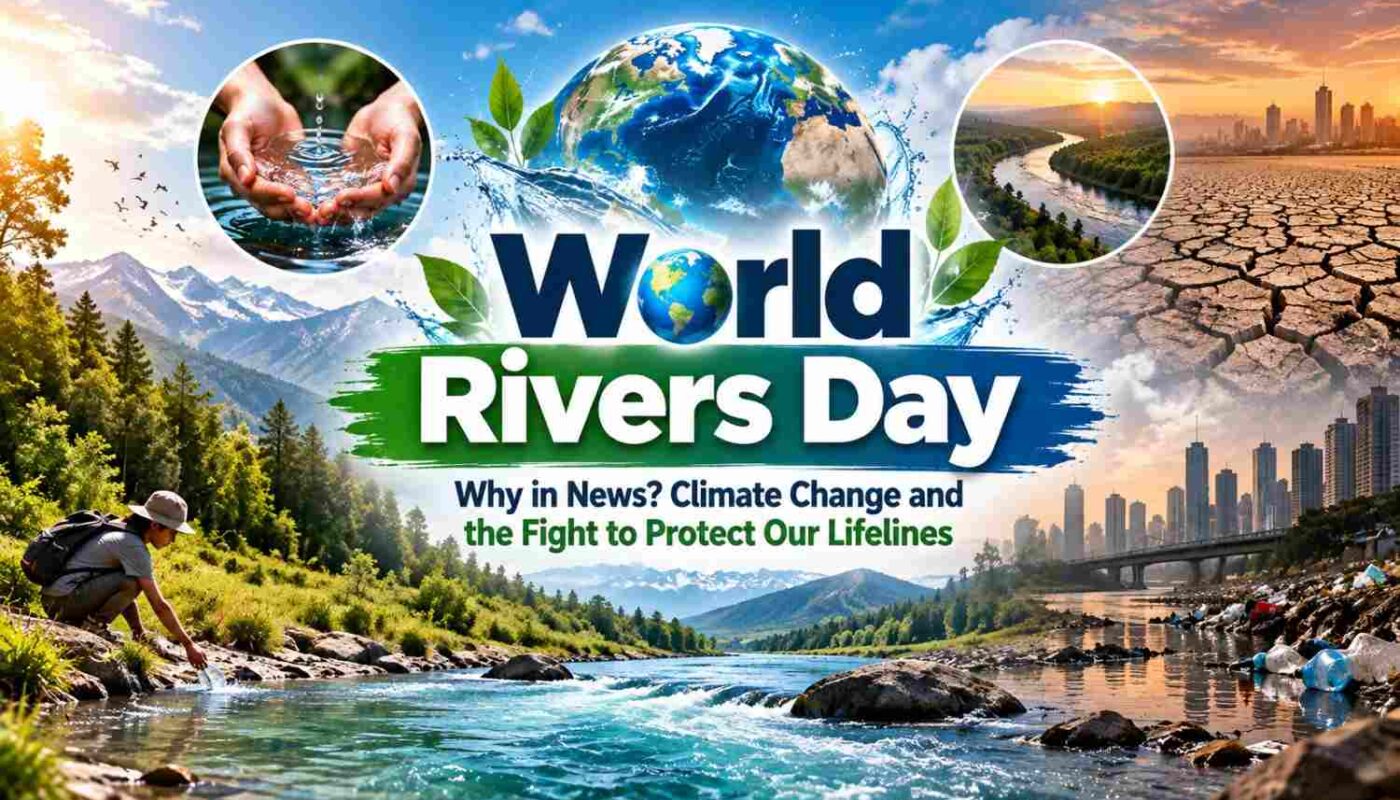
by World Rivers Day 2026 will be observed on Sunday, 27 September 2026, bringing global attention to the ecological, economic, social and cultural importance of rivers. Observed on the fourth Sunday of September every year, the day encourages people to understand the value of rivers and take action for their conservation.
With rivers facing growing pressures from pollution, urbanisation, excessive water extraction, dams, invasive species and climate change, World Rivers Day has become an important environmental observance for raising awareness about freshwater ecosystems and sustainable river management.
Why in News?
World Rivers Day 2026 will be observed on 27 September, with events planned across more than 100 countries. The global observance is expected to include river clean-ups, habitat restoration, educational programmes, community celebrations, school activities and other conservation initiatives.
The official World Rivers Day initiative describes the day as an opportunity to highlight the many values of waterways and encourage better stewardship of rivers around the world.
The 2026 observance is particularly relevant as freshwater ecosystems face increasing pressure from climate change, pollution, industrial development and unsustainable human activities.
World Rivers Day 2026: Key Highlights
| Particular | Details |
|---|---|
| Day | World Rivers Day |
| Date in 2026 | 27 September 2026 |
| Day | Sunday |
| Observed on | Fourth Sunday of September |
| First World Rivers Day | 2005 |
| Founder/Initiator | Mark Angelo |
| Origin | British Columbia Rivers Day, Canada |
| Main Objective | River conservation and public awareness |
| Participation | More than 100 countries |
| Major Activities | River clean-ups, restoration, awareness programmes, educational events |
| Key Concerns | Pollution, climate change, dams, over-extraction, urbanisation and habitat degradation |
What is World Rivers Day?
World Rivers Day is an annual international observance dedicated to celebrating the world’s rivers and highlighting their importance to people, wildlife and ecosystems.
The initiative aims to:
- Increase public awareness about rivers.
- Promote river conservation.
- Encourage responsible use of freshwater resources.
- Protect aquatic biodiversity.
- Support restoration of degraded waterways.
- Encourage community participation.
- Highlight threats facing rivers.
- Promote better stewardship of river ecosystems.
According to the official World Rivers Day organisation, millions of people in more than 100 countries participate in activities connected with the observance.
When is World Rivers Day Celebrated?
World Rivers Day is observed on the fourth Sunday of September every year.
Therefore:
- World Rivers Day 2025: 28 September
- World Rivers Day 2026: 27 September
- World Rivers Day 2027: 26 September
In 2026, the observance falls on 27 September.
History of World Rivers Day
The origins of World Rivers Day are closely associated with Mark Angelo, an internationally recognised Canadian river conservationist.
Angelo established BC Rivers Day in British Columbia in 1980. The success of the regional event eventually contributed to the development of a broader international celebration.
In 2005, the United Nations’ Water for Life Decade provided an international context for greater awareness of water resources. A proposal to establish a global rivers celebration was subsequently supported, leading to the first World Rivers Day in 2005.
Since then, the observance has expanded into an international event involving communities, schools, conservation organisations and governments.
Why Are Rivers Important?
Rivers are much more than channels carrying water from one location to another. They are fundamental components of natural ecosystems and human civilisation.
1. Source of Freshwater
Rivers provide freshwater for:
- Drinking
- Agriculture
- Industry
- Domestic use
- Livestock
- Hydropower
Millions of people depend directly or indirectly on river systems.
2. Support Biodiversity
Healthy rivers provide habitats for:
- Fish
- Amphibians
- Aquatic plants
- Birds
- Invertebrates
- Mammals
River ecosystems are connected to wetlands, forests, floodplains and coastal ecosystems.
3. Agriculture
River water supports irrigation and agricultural production in many regions.
Major river valleys have historically developed into important agricultural areas because of the availability of water and fertile sediments.
4. Hydropower
Rivers provide an important source of renewable energy through hydropower projects.
However, dams and river regulation can also alter natural river flows, sediment movement and aquatic habitats, making careful environmental planning important.
5. Livelihoods
Rivers support numerous livelihoods, including:
- Fishing
- Agriculture
- Tourism
- Transportation
- Handicrafts
- Recreation
6. Cultural Importance
Rivers have played a major role in the development of human civilisation and continue to hold cultural and spiritual significance in many societies.
Major Threats Facing the World’s Rivers
Despite their importance, rivers are under increasing pressure.
1. Water Pollution
Industrial waste, untreated sewage, agricultural runoff, plastics and other pollutants can degrade river water quality.
Pollution can affect:
- Human health
- Fish populations
- Aquatic plants
- Drinking-water supplies
- Agricultural activities
- River biodiversity
2. Climate Change
Climate change is increasingly affecting river systems through changes in:
- Rainfall patterns
- Snow and glacier melt
- Flood frequency
- Drought conditions
- River discharge
- Water temperature
Some regions may experience increased flooding, while others may face prolonged water shortages.
3. Excessive Water Extraction
Over-extraction of river water for agriculture, industries and cities can reduce environmental flows and place pressure on aquatic ecosystems.
4. Dams and River Modification
Dams can provide important benefits such as electricity, irrigation and flood management. However, river regulation can also affect natural flow patterns, sediment transport, fish migration and downstream ecosystems.
Therefore, river development requires consideration of both human needs and ecological requirements.
5. Urbanisation
Rapid urban expansion can lead to:
- Riverbank encroachment
- Loss of floodplains
- Increased sewage discharge
- Plastic pollution
- Reduced natural drainage
- Habitat destruction
6. Sand Mining
Unregulated or excessive extraction of sand from riverbeds can alter river morphology and affect aquatic and riparian ecosystems.
7. Invasive Species
Non-native species can disrupt aquatic ecosystems by competing with native species and changing ecological relationships.
World Rivers Day 2026 and Climate Change
Climate change has made river conservation an increasingly important environmental issue.
Rivers are closely connected with rainfall, glaciers, groundwater, forests and wetlands. Changes in temperature and precipitation can therefore affect the quantity and quality of river water.
Extreme events can create a difficult combination of:
Flood → erosion → infrastructure damage → water contamination
while prolonged drought can result in:
Low rainfall → reduced river flow → water scarcity → pressure on agriculture and ecosystems
World Rivers Day provides an opportunity to discuss how climate adaptation and river conservation can be addressed together.
World Rivers Day and India
World Rivers Day has particular relevance for India because the country has an extensive network of rivers supporting agriculture, cities, industries, biodiversity and cultural activities.
Major Indian river systems include:
- Ganga
- Yamuna
- Brahmaputra
- Godavari
- Krishna
- Narmada
- Mahanadi
- Kaveri
- Tapti
- Sabarmati
Indian river systems face challenges including pollution, untreated wastewater, groundwater depletion, encroachment, sand mining, altered flows and climate-related risks.
River conservation therefore requires a combination of pollution control, wastewater treatment, ecological restoration, sustainable water use, catchment management and community participation.
Ganga River Conservation and Namami Gange
The Ganga is one of India’s most important river systems and is central to several government programmes focused on river rejuvenation.
The Namami Gange Programme was launched by the Government of India to address pollution and rejuvenation of the Ganga and its tributaries.
Key areas of intervention include:
- Sewage treatment
- Industrial pollution control
- River-surface cleaning
- Biodiversity conservation
- Afforestation
- Public awareness
- Riverfront development
- Monitoring and enforcement
The programme illustrates how river conservation can involve multiple sectors rather than focusing solely on cleaning the river itself.
What is River Restoration?
River restoration refers to efforts to improve the ecological health and natural functioning of a degraded river system.
It can involve:
- Restoring natural river channels
- Reconnecting floodplains
- Improving water quality
- Restoring wetlands
- Replanting riverbank vegetation
- Removing pollutants
- Improving environmental flows
- Protecting aquatic biodiversity
Modern river management increasingly recognises that simply removing visible waste is not enough. A healthy river requires functioning ecosystems throughout its river basin or watershed.
How Can People Help Protect Rivers?
River conservation is not only the responsibility of governments.
Individuals and communities can contribute by:
- Avoiding disposal of waste into rivers.
- Reducing single-use plastic consumption.
- Participating in local river-cleaning activities.
- Conserving water at home.
- Supporting wetland and riverbank restoration.
- Avoiding dumping of chemicals and oils into drains.
- Spreading awareness about freshwater conservation.
- Supporting responsible tourism around rivers.
- Participating in community-based environmental programmes.
- Reporting illegal dumping or pollution where appropriate.
World Rivers Day 2026 Activities
World Rivers Day activities vary from country to country and community to community.
Common activities include:
- River clean-up drives
- Tree planting
- Habitat restoration
- Educational workshops
- School competitions
- Photography contests
- Paddling and river tours
- Public lectures
- Biodiversity surveys
- Community celebrations
- Online awareness campaigns
The official World Rivers Day platform encourages communities to organise their own events and activities.
World Rivers Day 2026: Important Current Affairs Points
For UPSC, SSC, Banking, Railway, State PCS and other competitive examinations, the following points are important:
- World Rivers Day 2026: 27 September.
- It is observed on the fourth Sunday of September.
- The first World Rivers Day was held in 2005.
- The initiative was inspired by BC Rivers Day.
- Mark Angelo is associated with the founding of World Rivers Day.
- BC Rivers Day was founded in 1980.
- The observance promotes river conservation and public awareness.
- Events are held in more than 100 countries.
- Major threats include pollution, climate change, excessive water extraction, dams, urbanisation and habitat degradation.
- River conservation is closely connected with freshwater biodiversity and climate resilience.
- India has major river systems including the Ganga, Brahmaputra, Godavari, Krishna, Narmada and Mahanadi.
- The Namami Gange Programme is India’s major initiative for Ganga rejuvenation.
World Rivers Day vs World Water Day
These two observances are sometimes confused.
| World Rivers Day | World Water Day |
|---|---|
| Observed on the fourth Sunday of September | Observed on 22 March |
| Focuses particularly on rivers and waterways | Focuses broadly on freshwater and water-related challenges |
| International river-conservation initiative | United Nations observance |
| Emphasises river stewardship | Addresses global freshwater issues |
World Rivers Day should therefore be understood specifically in the context of river ecosystems and river stewardship, while World Water Day has a broader freshwater focus.
Frequently Asked Questions
When is World Rivers Day 2026?
World Rivers Day 2026 will be observed on Sunday, 27 September 2026.
What is the purpose of World Rivers Day?
The primary purpose is to increase public awareness about the importance of rivers and encourage improved stewardship and conservation of waterways.
When was the first World Rivers Day observed?
The first World Rivers Day was held in 2005.
Who founded World Rivers Day?
Mark Angelo, a Canadian river conservationist, is credited with initiating World Rivers Day. He had earlier founded BC Rivers Day in 1980.
Is World Rivers Day a UN day?
World Rivers Day developed in connection with the UN Water for Life Decade, but it is best described as an international river-awareness and conservation observance rather than a United Nations-designated international day.
What are the major threats to rivers?
Major threats include pollution, climate change, excessive water extraction, dams and altered flows, urbanisation, invasive species and habitat degradation.
Why are rivers important?
Rivers provide freshwater, support biodiversity and agriculture, sustain livelihoods, contribute to energy production and have major cultural and ecological importance.
Conclusion
World Rivers Day 2026, observed on 27 September, is more than a celebration of waterways—it is a reminder that healthy rivers are fundamental to healthy societies and ecosystems.
From the Ganga and Brahmaputra in India to river systems across Africa, Europe, the Americas and Australia, rivers connect communities, landscapes and ecosystems. Yet pollution, climate change, unsustainable extraction and habitat degradation are placing increasing pressure on these freshwater lifelines.
The 2026 observance provides an opportunity for governments, environmental organisations, schools and communities to move beyond awareness towards practical river stewardship, restoration and sustainable water management.
For current-affairs preparation, remember the key facts: 27 September 2026, fourth Sunday of September, first observed in 2005, Mark Angelo, BC Rivers Day, and the central focus on river conservation and stewardship.