 by
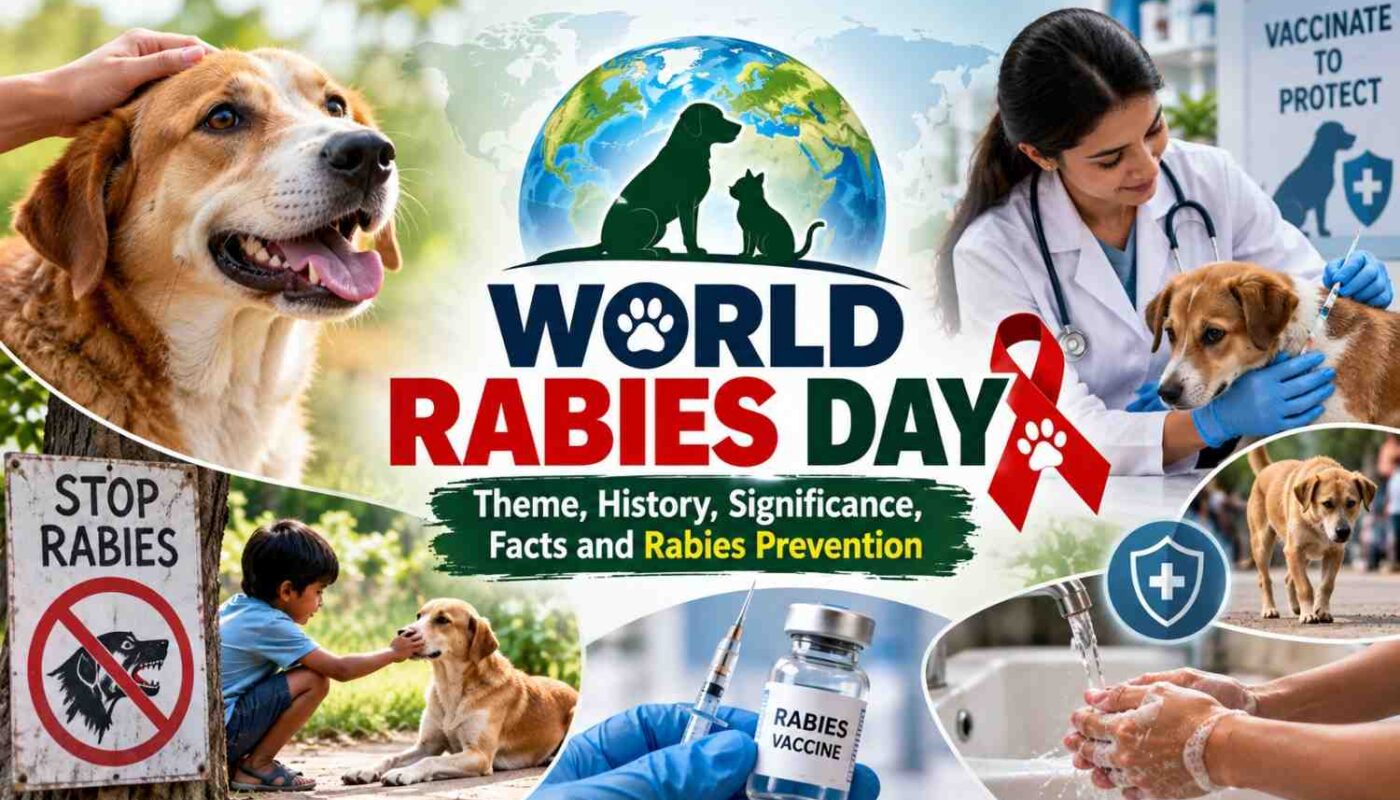
by World Rabies Day is observed every year on 28 September to raise awareness about rabies prevention, promote vaccination of dogs and other animals, improve access to post-exposure treatment, and support global efforts to eliminate human deaths caused by dog-mediated rabies.
In 2026, World Rabies Day will be observed on 28 September with the global theme “Stronger Together.” The theme emphasizes that eliminating rabies requires coordinated action involving communities, governments, healthcare workers, veterinary professionals, animal owners and international organisations.
World Rabies Day 2026: Key Highlights
| Particular | Details |
|---|---|
| Day | World Rabies Day |
| Date | 28 September 2026 |
| Day in 2026 | Monday |
| 2026 Theme | Stronger Together |
| Observed Since | 2007 |
| Disease | Rabies |
| Nature of Disease | Viral and zoonotic |
| Major Source of Human Transmission | Dogs |
| Major Mode of Transmission | Bite or scratch from an infected animal |
| Global Goal | Zero human deaths from dog-mediated rabies by 2030 |
| Approach | One Health |
What is Rabies?
Rabies is a vaccine-preventable viral zoonotic disease that affects the central nervous system. It can infect mammals, including dogs, cats, livestock and wildlife.
The virus is generally transmitted through the saliva of an infected animal, most commonly through a bite or scratch. According to the World Health Organization (WHO), dogs are responsible for up to 99% of human rabies cases. Once clinical symptoms appear, rabies is almost invariably fatal.
Despite being almost 100% fatal after the onset of clinical symptoms, rabies is preventable when appropriate action is taken promptly after exposure.
World Rabies Day 2026 Theme: “Stronger Together”
The theme for World Rabies Day 2026 is “Stronger Together.”
According to WHO, the theme highlights the importance of cooperation among different sectors to achieve rabies elimination. The organisation emphasises that vaccination, surveillance, public awareness, healthcare services, responsible animal ownership and government policies need to function together rather than independently.
The 2026 campaign particularly focuses on:
- Expanding access to life-saving dog vaccination.
- Strengthening rabies surveillance and reporting.
- Improving public awareness and education.
- Supporting responsible animal care.
- Strengthening policies for rabies prevention.
- Building community-led solutions.
- Promoting the One Health approach.
Why is World Rabies Day Observed on 28 September?
World Rabies Day is observed on 28 September every year.
The date commemorates the death anniversary of Louis Pasteur, the French scientist whose work with his colleagues contributed to the development of the first successful rabies vaccine in 1885.
World Rabies Day was first observed in 2007 and was established as an international awareness initiative to promote rabies prevention and control. India’s National Rabies Control Programme also identifies 28 September as World Rabies Day and notes its connection with Pasteur’s contribution to rabies vaccination.
Why is Rabies a Major Public Health Concern?
Rabies remains a significant public health challenge, particularly in Africa and Asia.
WHO estimates that rabies causes approximately 59,000 human deaths every year, although underreporting means the actual burden may be higher. Children are particularly vulnerable, with children under 15 accounting for a substantial proportion of cases.
The disease also creates considerable economic and social costs through healthcare expenditure, loss of livelihoods and premature deaths.
The good news is that rabies is preventable. Effective vaccines and post-exposure prophylaxis are available, while vaccination of dogs can significantly reduce transmission at its source.
How Does Rabies Spread?
Rabies is primarily transmitted through the saliva of an infected animal.
Transmission can occur through:
- Animal bites.
- Scratches that break the skin.
- Saliva entering an open wound.
- Saliva coming into contact with mucous membranes such as the eyes or mouth.
Dogs are the principal source of human rabies transmission globally. However, rabies can affect other mammals as well.
What Should You Do After a Dog Bite or Animal Scratch?
Immediate action following a potentially risky animal bite or scratch can be life-saving.
WHO recommends that people exposed to a potentially rabid animal should:
- Immediately wash the wound with soap and plenty of running water.
- Continue washing/flushing the wound for approximately 15 minutes.
- Seek medical attention as soon as possible.
- Follow the recommended post-exposure prophylaxis (PEP) prescribed by a healthcare professional.
- Where clinically indicated, rabies immunoglobulin or appropriate alternatives may be administered.
People should not rely on home remedies or delay medical treatment after a potentially risky exposure. WHO specifically advises against applying irritants such as chilli powder, plant juices, acids or alkalis to the wound.
What is Post-Exposure Prophylaxis (PEP)?
Post-Exposure Prophylaxis (PEP) is medical treatment provided after a person has potentially been exposed to rabies.
Depending on the exposure and medical assessment, PEP can include:
- Thorough wound washing.
- A course of rabies vaccine.
- Rabies immunoglobulin or monoclonal antibodies when indicated.
PEP works by preventing the virus from reaching the central nervous system. When administered appropriately and promptly, it can prevent the development of rabies after exposure.
Role of Dog Vaccination in Rabies Elimination
Vaccinating dogs is one of the most important strategies for preventing human rabies.
WHO and its partners promote mass dog vaccination because controlling rabies at its animal source can interrupt transmission to humans.
WHO recommends achieving high vaccination coverage among dogs as part of comprehensive rabies-control programmes. The organisation’s approach combines animal vaccination with access to human PEP, surveillance, education and bite prevention.
One Health Approach to Rabies
The One Health approach recognises that human health, animal health and environmental health are interconnected.
Rabies is an important example of why cooperation between these sectors is necessary.
Effective rabies control requires coordination among:
- Health departments.
- Veterinary services.
- Local governments.
- Animal welfare organisations.
- Healthcare professionals.
- Communities.
- Schools and educational institutions.
- Pet owners.
- International organisations.
The 2026 World Rabies Day theme, “Stronger Together,” reinforces this coordinated approach.
India and Rabies Control
India has implemented the National Rabies Control Programme (NRCP) to prevent human deaths from rabies and strengthen rabies-control activities.
The programme focuses on areas including:
- Prevention of human deaths from rabies.
- Increasing community awareness.
- Training healthcare personnel.
- Strengthening surveillance.
- Improving diagnostic facilities.
- Supporting coordination between human and animal health sectors.
The National Rabies Control Programme is coordinated by the National Centre for Disease Control (NCDC) for its human-health component. India’s official rabies-control portal also provides information on vaccination schedules, rabies immunoglobulin and rabies-related public-health initiatives.
Global Progress Towards “Zero by 30”
The global rabies community has adopted the “Zero by 30” goal, which aims to end human deaths from dog-mediated rabies by 2030.
A significant development in 2026 came from Bhutan. WHO announced in September 2026 that Bhutan had been validated as having eliminated dog-mediated human rabies as a public health problem. WHO reported that Bhutan had recorded zero human deaths from dog-mediated rabies since June 2023.
According to WHO’s September 2026 rabies fact sheet, Bhutan, Chile and Mexico had been validated for elimination of dog-mediated human rabies as a public health problem.
Bhutan’s progress demonstrates the importance of sustained dog vaccination, access to PEP, surveillance, responsible animal management and community participation.
Rabies: Important Facts for Competitive Exams
- World Rabies Day: 28 September.
- World Rabies Day 2026 Theme: “Stronger Together.”
- First observed: 2007.
- Rabies: Viral zoonotic disease.
- Major source of human rabies: Dogs.
- Major route of transmission: Saliva through bites or scratches.
- Central target of the virus: Central nervous system.
- Once clinical symptoms appear: Rabies is almost invariably fatal.
- Prevention: Animal vaccination, bite prevention and timely PEP.
- Global target: Zero human deaths from dog-mediated rabies by 2030.
- Approach: One Health.
- 28 September connection: Death anniversary of Louis Pasteur.
- India’s programme: National Rabies Control Programme.
- WHO estimate: Around 59,000 human rabies deaths annually.
- Majorly affected regions: Africa and Asia.
Significance of World Rabies Day 2026
World Rabies Day 2026 is significant because it shifts attention from awareness alone toward coordinated action.
The theme “Stronger Together” underlines the fact that rabies cannot be eliminated by the health sector alone. Dog vaccination, responsible pet ownership, accessible medical treatment, public education, surveillance and effective government programmes must work together.
The recent validation of Bhutan’s elimination of dog-mediated human rabies also provides a concrete example of how sustained national action and community participation can contribute to the global Zero by 30 objective.
Frequently Asked Questions on World Rabies Day
World Rabies Day is observed every year on 28 September.
The theme of World Rabies Day 2026 is “Stronger Together.”
It is observed to increase awareness about rabies prevention, animal vaccination, bite prevention, timely medical treatment and global rabies elimination.
Yes. Rabies is preventable through measures such as animal vaccination, avoiding exposure and receiving appropriate post-exposure treatment promptly after a potentially risky exposure.
Yes. Once clinical symptoms develop, rabies is almost invariably fatal.
Dogs are responsible for up to 99% of human rabies cases, according to WHO.
“Zero by 30” is the global objective of ending human deaths from dog-mediated rabies by 2030.
The wound should be washed thoroughly with soap and running water for about 15 minutes, followed by immediate medical assessment for appropriate post-exposure prophylaxis.
Conclusion
World Rabies Day 2026, observed on 28 September under the theme “Stronger Together,” highlights the importance of collective action to prevent rabies and achieve the global goal of eliminating human deaths from dog-mediated rabies by 2030.
For competitive-exam aspirants, the most important facts to remember are the date (28 September), theme (“Stronger Together”), first observance (2007), Louis Pasteur connection, One Health approach, National Rabies Control Programme, and Zero by 30 goal.
Rabies remains a serious disease, but unlike many fatal diseases, the tools needed for prevention already exist. Timely wound care, appropriate post-exposure treatment, vaccination of dogs, surveillance and community awareness can play a decisive role in preventing deaths.