 by
by A personal, inspiring tale of failing the PMP exam twice—and finally mastering it. Real tips, raw honesty, and hope for IT pros chasing PMP success.
Introduction: A Setback That Sparked Growth
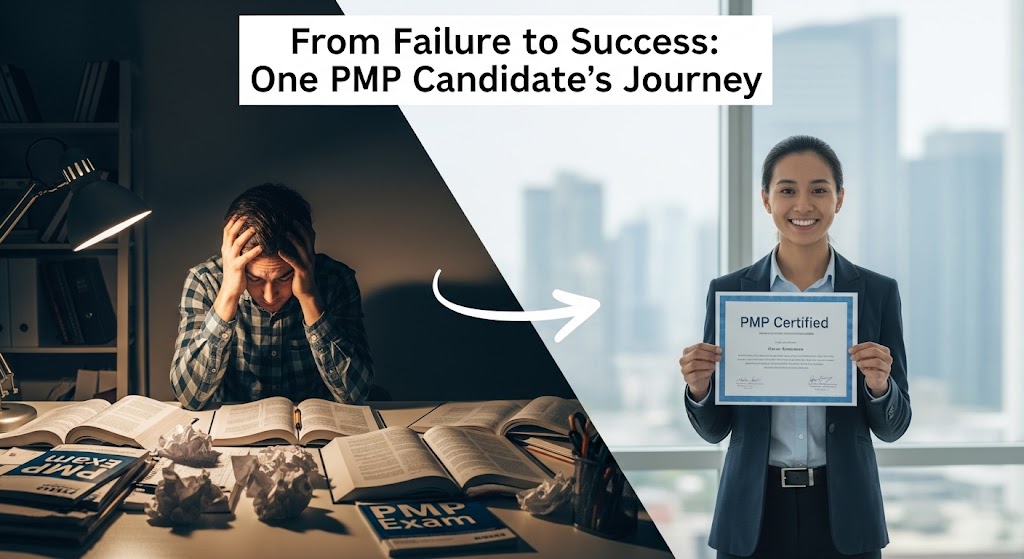
Have you ever felt like no matter how hard you try, success keeps slipping through your fingers? That was me, sitting in the exam center for the second time, staring at the screen reading “Not Proficient.” My dream of earning the PMP Certification, my ticket to advancing in my IT career, felt crushed. Yet, looking back now—I’m the one with the certificate in hand. How did I turn that failure into a breakthrough? Stick with me, and I’ll take you through every step of my transformation.
The First Attempt—Overconfidence Meets Reality
I entered the PMP Training boot camp confident but quickly realized I’d made a mistake. I thought the PMP Boot Camp and a casual review of the PMBOK® Guide would suffice. Spoiler: it didn’t. The exam questions weren’t just academic—they called for sharp, contextual thinking about risk, quality, and real-world scenarios. I failed. Hard. That “Not Proficient” hit me like a ton of bricks.
But it also lit a fire. In that moment, I chose not to quit.
The Pivot—Rethinking My Study Strategy
After my first failure, I hit pause. Instead of diving back into rote learning, I:
- Joined a study group—we discussed real IT projects, not just theory.
- Practiced mock exams under timed conditions—replicating the real thing.
- Focused on problem areas—especially risk management and change control.
These weren’t just buzzwords on a project management course outline—they were the bread and butter of everyday project work. Slowly, I began thinking in a PMP way, not just memorizing it.
The Second Attempt—More Prepared, Less Panicked
So, I went back—again. I sat for the exam with guarded optimism. It felt smoother… until another “Not Proficient.” Another gut punch. But this time, something clicked. I realized better planning and knowledge wouldn’t be enough without the right mindset. I needed to think like a PMP, not just know what a PMP thinks.
The Breakthrough—Study Smarter, Not Harder
After two failures, I managed to regroup:
- I used PERT techniques to realistically estimate study time—no more all-nighters; just manageable, scheduled sessions I treated every “wrong” answer on a practice test as a learning opportunity.
- I made sure to simulate full-length tests to build mental endurance.
Mid-study, I also signed up for an extra PMP Certification Training course by Sprintzeal to get fresh perspectives and strategiesThe instructor introduced real-life scenarios—like how hybrid teams handle scope creep—and that resonated with my IT background.
The Final Push—Conquering the Exam
Test day three? I entered the center calm, confident, prepared. The four-hour marathon flashed by. I recognized the traps; I caught the trick questions; I leveraged my real-world experience. And this time when the result appeared—Proficient—my heart skipped.
Conclusion: Your Journey Doesn’t End with Failure
Here’s what I want you, dear reader, to take away:
- Failing is not fatal—it’s feedback.
- Blend real experience with structured training—you need both.
- Plan with PERT for study time, take mocks seriously, and simulate the exam environment.
you’re eyeing that program management professional certification or project manager certification, know this: the path may have bumps, but every stumble is step building to success. You just have to keep moving
If you’re ready to take that next step:
- Explore structured PMP Boot Camp options like Sprintzeal’s for exam-aligned learning
- Join a study group or take a project management professional certification prep course.
- Start building mastery—risk, change, quality, process—one mock exam at a time.
You’ve got this. The title PMP isn’t just letters—it’s proof of grit, knowledge, and growth.